Circular shaped architecture in Copenhagen, Denmark

Maximizing the Efficiency of Clean Steel Production and Achieving Cost Competitiveness
A conversation with Dr. Luca Mastropasqua, head of the Hydrogen and Electrochemistry Research for Decarbonization (HERD) Laboratory at the University of Wisconsin-Madison.
Clean steel production will require an enormous amount of clean energy. Producing green hydrogen, operating high-temperature gas heaters, and powering electric arc furnaces will dramatically increase electricity demand at primary steel mills in the United States, and demand could reach gigawatt scale for individual commercial facilities. Therefore, every unit of energy (electrical, heat, or chemical) avoided or reused reduces the scale and cost while accelerating the speed of the renewable buildout required to support commercial-scale near-zero steel production. Improving energy efficiency is sometimes viewed as primarily a strategy for making incremental improvements to legacy infrastructure, but it will also be foundational to making new, deeply decarbonized pathways competitive and viable.
Finding hidden efficiencies
For more than a century, industrial manufacturers have understood the value of efficiency. Steel, cement, and chemical producers have long sought to recycle waste heat, byproduct gases, and residual materials, though not primarily for climate reasons, but because doing so lowers costs and improves competitiveness. Industrial recycling has often been, at its core, an energy strategy. Facilities routinely investigate opportunities to capture value from solid, liquid, and gaseous streams through onsite reuse or external sales.
Yet one major waste stream has largely eluded this efficiency-driven approach: carbon dioxide (CO₂) rich flue gas. In conventional ironmaking, carbon monoxide (CO) and hydrogen (H₂), derived from coal or natural gas, reduce iron ore (FeOₓ) into metallic iron (Fe), producing CO₂ and water in the process. These gases are typically vented to the atmosphere, representing not only a major source of emissions but also lost molecular value and embedded energy.
From flue gas to value
Unlike scrap steel or waste heat, flue gas emissions have historically been viewed as unavoidable and unusable. Flue gas streams are often diluted and contaminated with particulate matter, water vapor, and other impurities. CO₂ itself is chemically stable and does not readily participate in further reactions without significant energy input. For these reasons, it has long been treated as waste rather than as a resource that could be recaptured and reused, but that is starting to change.
Researchers at the Hydrogen and Electrochemical Research for Decarbonization, or HERD Lab, at the University of Wisconsin-Madison are developing a system designed to recycle steelmaking flue gas. Using solid-oxide electrolyzers (SOE), the team converts streams of CO₂ and water (traditional flue gases) back into carbon monoxide and hydrogen (recycled top gases in Exhibit 1). These regenerated molecules can then be reintroduced into the iron reduction process, creating a near-closed-loop system that minimizes waste and maximizes energy productivity.
In addition to the HERD lab the project team is comprised of several others, including industry partners Cleveland-Cliffs (Cliffs), FuelCell Energy (FCE), and Electric Power Research Institute (EPRI), and partners in research and academia, i.e., Laboratorio Energia Ambiente Piacenza (LEAP), University of California, Irvine (UCI), Politecnico di Milano (PoliMi), and University of Wisconsin-Madison (UWM). Cliffs works as the Toledo iron plant operator and system integrator, while FCE is the SOE manufacturer and balance of plant integrator. LEAP and PoliMi are responsible for system design, flexible operation and carbon utilization, while UCI is responsible for developing SOE system control strategies. EPRI focuses on techno-economic analysis and life-cycle analysis of the full-scale system.
Electrolyzers are not new, but what distinguishes SOE systems is their ability to operate efficiently at the high temperatures common in steel production. SOEs can leverage industrial heat and pressure conditions to improve the thermodynamic efficiency of hydrogen production. When integrated into a direct reduced iron facility, this approach can dramatically reduce overall fossil fuel consumption and decrease typical electrical energy demand for electrolysis by leveraging available heat energy.
In practical terms, that means fewer installed renewable megawatts are required to produce a ton of near-zero steel. By reducing total energy intensity and recycling key molecules within the process, technologies like this can shrink the renewable energy burden associated with deep decarbonization and make the transition more achievable in the near term.
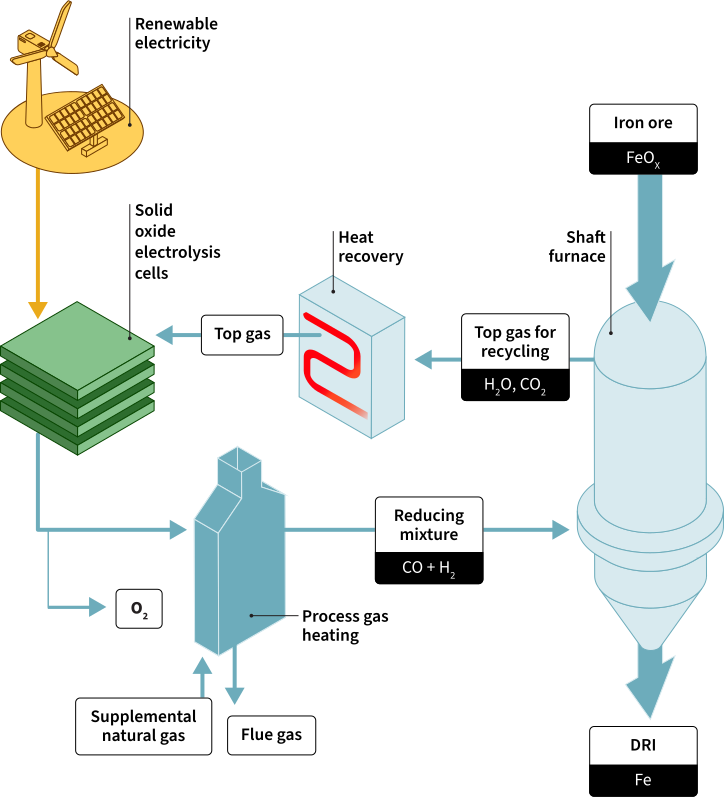
Exhibit 1: Integrated SOE-DRI configuration
We recently sat down with Dr. Luca Mastropasqua, who leads the HERD Lab research team, and RMI steel expert Nick Yavorsky to discuss how this technology works, what it could mean for steelmakers and regional economic development, and what comes next. The conversation has been edited and condensed for clarity.
RMI: Dr. Mastropasqua, what excited you the most about the potential for this technology?
Dr. Mastropasqua: This technology is one of the few able to reduce ironmaking emissions by more than 94% compared to typical natural gas DRI systems (~500 kgCO₂/tDRI vs ~30 kgCO₂/tDRI) and 98.5% compared to coal-based blast furnace basic oxygen furnace production. At the same time, this technology will minimize the use of total energy inputs (either fossil or renewable sources). This technology shows energy savings of approximately 40% against traditional natural gas DRI (11 GJ/tDRI vs 8 GJ/tDRI) and 10% compared to other hydrogen DRI systems (9 GJ/t DRI vs 8 GJ/t DRI).
One of the most synergistic aspects of this technology is that we are not only doing thermal integration, in the form of waste heat recovery, but also chemical integration. We are recovering chemical content and upgrading it to a more valuable stream, rich in hydrogen, that can be repurposed to displace additional natural gas.
RMI: How does your research and technology demonstration advance from where it is today?
Dr. Mastropasqua: The SOE technology must be demonstrated at the megawatt scale in real industrial sites before commercial-scale systems can be deployed. This is key to developing the necessary manufacturing capacity to cut manufacturing costs. We need to build gigafactories in the same way we did for Li-ion batteries. This will allow us to convince the steel industry (as well as many other industrial sectors) that SOE systems can be utilized for behind-the-meter, on-site hydrogen and syngas generation at the scale required by current plants (i.e., 100s MW of equivalent hydrogen, and GW-scale electrical capacity).
I expect that, if the main US manufacturers of SOE systems continue with their capacity build-up, we should be able to get to full commercial scale in the next 5-8 years.
RMI: Globally, we expect DRI production to increase in the coming decades. Can you explain how greenfield deployment of your technology has different implications than retrofits at existing assets?
Dr. Mastropasqua: The main difference between brownfield and greenfield deployment for this application is connected to the primary energy source of choice, i.e., fluctuating energy source like solar or wind versus firmed resource like fossil fuels, grid, geothermal, or nuclear. Since ironmaking plants want to operate at steady state close to their nominal design point for 8,000 hours a year, coupling with an intermittent resource requires large buffer systems: hydrogen storage, syngas storage, or thermal storage. On the other hand, existing brownfield systems could install an SOE plant to upgrade their reducing stream without the need for large-scale storage facilities, if their primary electricity source comes from the grid. However, this solution does not guarantee the same degree of decarbonization, given that most of the US electric grids don’t have a sufficiently low carbon intensity yet. As far as the shaft furnace technology is concerned, they have already been demonstrated to be able to operate with pure hydrogen.
RMI: How does your proposed technological solution compare to carbon capture and storage (CCS) or other forms of retrofitted decarbonization technologies at steel mills?
Dr. Mastropasqua: Some CCS technologies have a breakeven cost of carbon that is competitive with current cap and trade systems in EU. In the United States, the 45Q tax credits provide a real incentive to install CCS systems for enhanced oil recovery or permanent storage. However, most CCS systems (post-combustion, pre-combustion, or oxyfuel) have a specific primary energy consumption per unit of CO₂ avoided (SPECCA index) that varies between 2-4 MJ/kgCO₂. This means that plant owners must consume between an additional 2-4 MJ of primary energy relative to their usual consumption to capture every kg of CO₂. This translates into additional energy supply costs. With an SOE, the SPECCA index would be negative! We would be able to avoid the emission of CO2 and reduce the primary energy consumption at the same time.
CCS technologies certainly have a role in decarbonizing heavy industries, and we have worked on electrochemical carbon capture and storage technologies applied to the steel sector that show SPECCA values close to zero, i.e., do not introduce any energy penalty compared to a non-CCS system. One should also consider the availability of CO₂ storage sites, which can become a limiting factor, considering the amount of CO₂ that the steel sector alone cumulatively emits.
RMI: Nick, how does this type of facility upgrade impact the workforce onsite for DRI facilities? What kind of impact could it have on the long-term steel workforce in the US?
Nick Yavorsky (RMI): As highlighted by Dr. Mastropasqua, the energy efficiency implications for an integrated SOE system at primary steel production sites are immense, but its potential to provide regional economic value for those who choose to implement is also considerable. As a retrofit system, this technology could introduce anywhere from 100 to 400 additional full-time employees, depending on integration and automation. This does not include the several hundred construction workers required to implement the retrofit system or the thousands of workers needed to construct, operate, and maintain the hundreds of megawatts of upstream renewable energy resources needed to supply the SOEs with clean power.
In addition to the regional workforce growth potential, these types of systems will help US steelmakers produce more valuable products. Potentially accessing a higher price via a market premium while responding to high demand globally, production of near-zero DRI or crude steel products would support the continued operation of US assets for decades to come, with ample opportunity for expansion and continued reinvestment.
Greenfield sites offer the best opportunity to realize the market potential for this technology. Although it can be applied at existing facilities, new plants can likely achieve the greatest energy demand reduction as key systems can be designed intentionally from the start. As indicated by Dr. Mastropasqua’s1 energy and emissions reductions estimates, sites where thermal and chemical integration are paired with energy storage capacity and flexible operation schemes are positioned to become the most attractive for producers looking to maximize profits and compete against other global near-zero emissions approaches.
Fundamentally, deploying energy, cost, and climate-efficient systems like this one can help to revitalize the dwindling US primary steel production base and the economic prosperity it brings.
RMI: Are there any other groups exploring similar technology pathways?
Nick Yavorsky (RMI): Yes, in addition to the research being conducted at the HERD lab, the team at Helix Carbon is also exploring the reuse potential of steel production off-gases as a means of reducing energy demand onsite. That’s good news, because energy efficiency innovations that increase the cost competitiveness of clean industrial solutions are greatly needed, and the more arrows in the technological quiver, the better.
With both groups producing promising modeling results backed by extensive lab testing, the hunt for commercial partnerships and deployment opportunities is on. Incumbent steel manufacturers in the US and abroad will soon be clamoring to incorporate these types of systems to reduce operating costs and help clean up their production.
RMI: What are some of the remaining challenges with continuing and scaling your work?
Dr. Mastropasqua: There are still quite a few research and development questions that must be addressed to increase the lifetime of these systems, especially when expected to operate with “dirty” feedstocks typical of the ironmaking sector.
Some exciting research avenues show that we can tailor the operation of the SOE system to match specific compositional targets for integration in DRI systems. This will make these electrolysis systems a drop-in replacement for the conventional steam reformers generally used for syngas production.
Public funding and support are key to demonstrating continued interest in US manufacturing industries that need to scale up capacity. Similarly, investment in R&D at universities is needed to support overcoming longer-term material degradation challenges, as well as educating future workers on electrochemical technologies.
Finally, an ecosystem of industry, national labs, philanthropies, and academia working in collaboration to demonstrate these technologies at industrial scale can further accelerate impact.
The big idea
Efficiency improvements have long been leveraged at industrial sites. Now, it is time for the next generation. Technologies like this point to a pathway where energy savings and emissions reductions go hand in hand, reducing overall energy use, making the scale of the challenge easier to solve, and ultimately unlocking a faster, more competitive future for iron and steelmaking over the next century.