From Pilot to Practice: Lessons from LC3 Deployment in India
Early pilots of the low-carbon cement show strong momentum, but supply chains, mix design, and market alignment still limit scale.
The importance of embodied carbon emissions in the fast-growing Indian economy has gained significant awareness in recent years. Major Indian cement and steel manufacturers, real estate developers, and tech companies have published net-zero roadmaps, corporate climate commitments, and sustainability targets. Within this context, many companies have taken aim at cement and concrete as they look to shrink their carbon footprints.
For instance, Lodha Developers has identified that concrete accounts for approximately half of the company’s Scope 3 emissions, based on Lodha’s internal embodied carbon baselines. Over the years, Lodha has conducted various pilots with emerging low-carbon concrete mixes, with the goal of mainstreaming their adoption across the company’s portfolio. One promising product is concrete made with Limestone Calcined Clay Cement (LC³) rather than ordinary Portland cement. LC3 uses limestone and clay in the mix to reduce the use of carbon-intensive clinker, thereby slashing emissions by up to 40 percent.
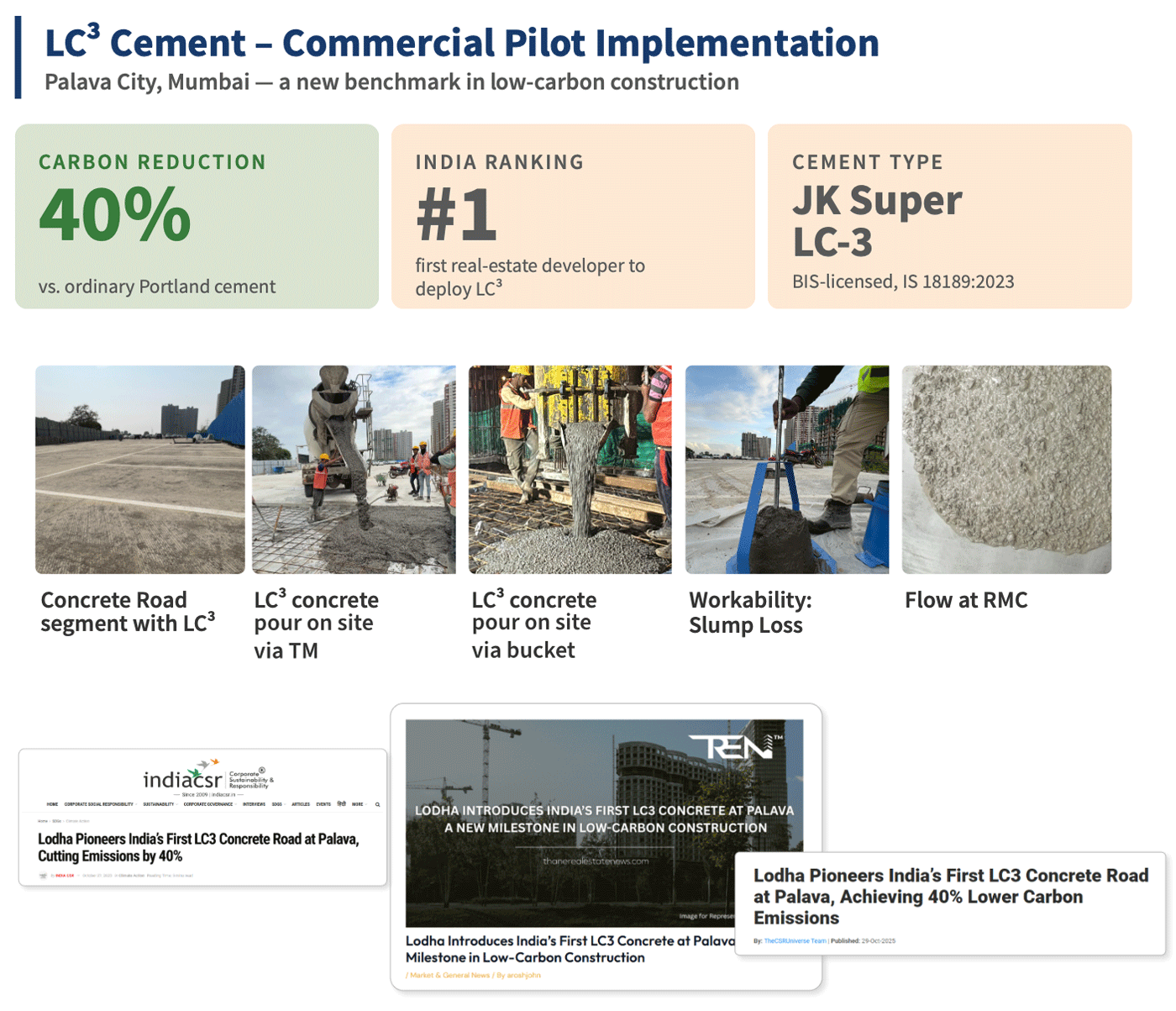
Through early engagement with premier research institutions, cement producers, ready-mix concrete suppliers, and admixture manufacturers, Lodha Developers has successfully deployed India’s first commercial-scale LC3 pilot. These implementation experiences revealed that while LC3 has real momentum, market readiness remains uneven across the value chain. Several on-the-ground hurdles must be addressed for wider adoption of LC3 in India. Intent is no longer the bottleneck — the challenge lies in translating this momentum into mainstream implementation.
Momentum for LC3
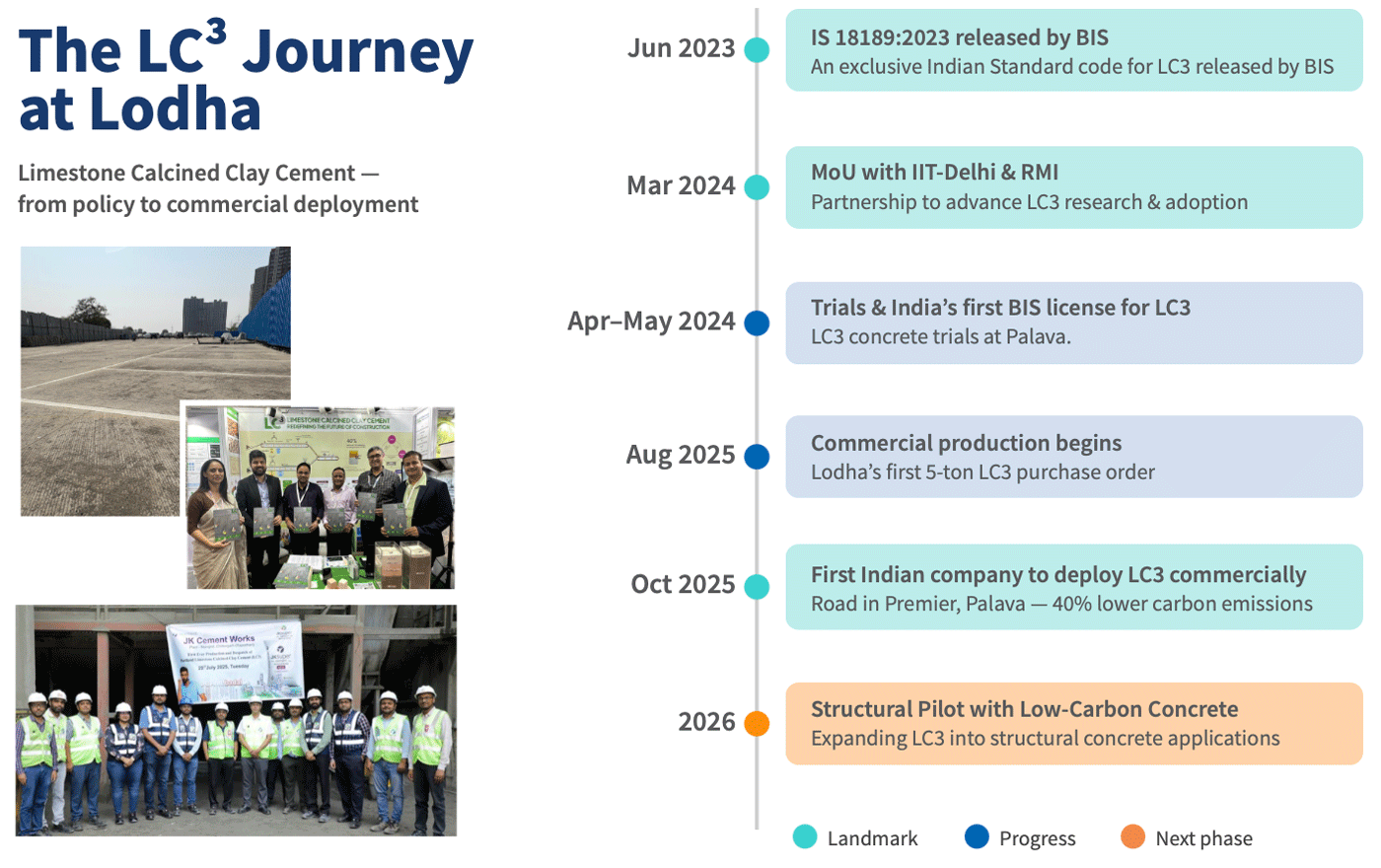
India has built strong tailwinds for Limestone Calcined Clay Cement, but supply chain readiness to deploy it at scale lags behind. On the policy front, an exclusive Indian Standard code for LC³ (IS 18189:2023) now provides a formal technical foundation for its use. The inclusion of LC3 within the clean technology targets of the Carbon Credit Trading Scheme (CCTS) and offset mechanisms also adds a direct economic incentive, linking low-carbon cement production to India’s emerging carbon market. On the supply side, commercial production of LC³ has now begun in parts of the country, and pilots are underway. Early adopters have started moving beyond intent and commitments toward on‑the-ground experimentation.
Gaps in the Value Chain
Successful use of LC3-based concrete mixes in construction projects requires coordination across the supply chain, from cement manufacturers, ready-mix concrete (RMC) suppliers, and admixture companies to structural consultants, contractors, quality teams, and builders.
Cement Is Ready, but Concrete Is Not
Although LC³ is now commercially available, standardized designs for concrete mixes based on LC3 remain under development for various structural applications. Concrete performance depends on the interaction between binder chemistry, aggregates, admixtures, batching conditions, transport time, local weather, and other variables. These variables need to be optimized for each context. A developer or RMC producer who wants to use LC³ today cannot simply substitute it into an existing mix design. They must invest in concrete mix optimization, which is neither budgeted for nor expected in most projects.
The fresh‑concrete behavior, strength development, and durability characteristics of LC3 concrete mixes require closer monitoring. In early LC³ deployments at Lodha Developers, teams have worked through practical issues related to workability, pumpability, slump retention, water demand, setting time, and strength development. Admixture optimization trials revealed higher rheological sensitivity for LC3 systems and rapid slump loss within 60 minutes. Specialized admixtures, such as polycarboxylate ether–based dispersants combined with a phosphoric acid modifier, were used to successfully achieve a three-hour workability window. None of these issues are unusual in material transitions, but they do require time, repeated trials, and close collaboration between supply chain partners. Scaling LC³ depends as much on concrete engineering and execution capability as it does on cement production.
Reliable Cement Supply Remains Critical
LC³ cement production in India is in its early commercial stages. In the current market, LC³ production often depends on aggregated demand. Without sufficient volume, it can be difficult for plants to economically run dedicated LC³ production days. This means project teams may be able to secure initial quantities for trials but may then struggle to obtain repeat supply aligned with construction schedules. For developers and contractors, such uncertainty in material availability can diminish internal confidence and delay adoption.
India produced approximately 400 million metric tons of cement in 2022, with demand projected to reach around 700 million metric tons by 2035. Some scenario analysis suggests that LC³ could capture 15 to 50 percent of this market under low-carbon pathways, equivalent to 105 million to 350 million metric tons annually by 2035. The implication is clear: while the long-term opportunity is significant, supply ecosystems must scale rapidly to match it.
Scaling LC3 Depends on RMC Readiness
Ready-mix concrete (RMC) producers sit at the center of this transition, and their readiness will heavily influence the pace of adoption. Many plants are optimized for conventional materials and established operating procedures. Introducing a new binder such as LC3 requires additional silos for storage, operator retraining, revised batching protocols, and modified quality control systems. Where margins are tight and project timelines are unforgiving, any operational change can be perceived as risk.
Carbon Remains an Afterthought, Not a Design Parameter
Design and procurement processes prioritize structural performance and compliance, leaving embodied carbon outside core decision criteria and limiting the uptake of low‑carbon binders such as LC³. As a result, each project must independently navigate design approvals, material acceptance, and internal quality control processes. Until embodied carbon becomes a key decision variable and LC³ becomes a preapproved option within specifications, adoption will remain outside the mainstream.
Even where embodied carbon reductions are prioritized, a lack of data on the carbon footprint of new products currently constrains their use. Environmental Product Declarations (EPDs), the industry standard for comparing the embodied carbon of materials, are not yet available for LC3. As more companies set embodied carbon targets and institutions demand credible reporting, verified embodied carbon data will become increasingly important for procurement and reporting purposes.
What’s Needed to Unlock Scale
Scaling LC³ requires more than just increasing reliable cement supply. It requires aligning materials, markets, and use cases in a way that reflects regional realities and existing infrastructure constraints.
Regional Strategy Will Determine Competitiveness
The market for low-carbon binders varies widely across India. Regional variations in material availability and quality shape the relative competitiveness of different supplementary cementitious materials (SCMs) — materials added to a concrete mix in place of ordinary Portland cement (OPC). A systematic regional assessment is necessary to map the availability and quality of various SCMs across India, followed by modeling the performance and economics of different blended cements by geography.
For instance, LC³ cannot compete with other SCMs such as ground granulated blast furnace slag (GGBS) or fly ash, especially in urban markets where GGBS supply chains are deeply established and economically favorable. LC³ has its strongest value proposition in markets and segments where alternative SCMs are scarce, and where OPC remains dominant. The low-grade limestone and clay required for LC3 production are abundantly available and well distributed across India.
Identify First-Use Segments
Not every application needs to move first, and not every application carries the same risk profile. LC³ adoption should follow a “use‑case ladder” rather than a blanket approach. Non-structural elements, pavement, roads, and infrastructure offer logical entry points: these segments are typically OPC‑dominant, demand large concrete volumes, and allow greater flexibility for mix optimization. Early successes in such applications help build confidence, generate performance data, and create reliable demand without introducing disproportionate structural risk.
Solve for Economics and Scale Together
Cost-competitiveness and availability must be addressed simultaneously. Without coordinated demand, supply remains opportunistic. Without reliable supply, developers cannot commit. Without such coordination, LC³ may remain confined to pilot‑scale deployments. This circular dynamic can only be resolved through stronger market signals. Demand aggregation through public procurement or coordinated commitments from large private-sector buyers is critical to justify long production runs, unlock more dependable supply, and stabilize supply chains.
Global Comparisons Matter, but Context Matters More
Some markets have moved faster on LC³ where new cement capacity is being added (e.g., Africa) or where domestic production is replacing imported clinker (e.g., China). Lessons from international markets should be interpreted carefully, as India’s challenges are different. As the world’s second-largest cement manufacturer, India already has massive production infrastructure. Transitioning such a system is inherently more complex than starting from a blank slate. Existing assets, established supply chains, and commercial realities all shape the speed and direction of change. This does not reduce the opportunity for LC³, but it does mean that the pathway to scale will be different. India’s transition will depend less on leapfrogging and more on integrating new solutions into a mature and fast-growing construction ecosystem.
From Pilots to Pathways
LC³ has moved beyond technical possibility in India, and market awareness is no longer the primary constraint. The technical standards exist, commercial production has begun, and major developers are paying close attention. Mainstream adoption will now require identifying the right first-use segments, establishing supply chain reliability, narrowing the first-cost premium, standardizing concrete mix design, updating internal quality control and approval workflows, and mapping regional economics and SCM availability with enough granularity to guide investment decisions. LC³ is an important addition to India’s broader portfolio of decarbonization pathways, and its success will depend on creating the commercial and ecosystem conditions to scale it consistently and competitively.
Acknowledgements
RMI India Foundation:Sai Sri Harsha Pallerlamudi, Tarun Garg, Lodha Foundation: Dr. Lav Singh