Clearing the Air on Reclaimed Refrigerant
Evidence of performance parity with virgin refrigerant
Summary
Refrigerants are essential to the operation of air conditioning, refrigeration, and heat pump systems that support modern life. As cooling demand grows and electrification of heating accelerates, the total stock of refrigerant-containing equipment is expected to increase, both in the United States and worldwide. At the same time, a large and long-lived base of existing equipment will continue to require ongoing servicing.
Yet many commonly used refrigerants are hydrofluorocarbons (HFCs), which have a global warming potential (GWP) hundreds to thousands of times higher than carbon dioxide. As a result, they contribute disproportionately to greenhouse gas emissions.1
To address these emissions impacts, the United States is phasing down HFC production under the American Innovation and Manufacturing (AIM) Act and transitioning to lower– GWP alternatives. However, because existing equipment will remain in service for years to come, demand for legacy refrigerants will persist even as production declines. This creates a structural gap between declining supply and ongoing servicing demand, particularly for R-410A, a refrigerant with GWP of about 2000, that is used in a majority of residential and commercial air conditioning systems in operation today.
Meeting this demand will require more effective management of refrigerant already contained within the installed base of cooling equipment, where significant volumes remain embedded in equipment at the end of its useable life. For example, R-410A accounted for 39% of all HFCs in use in 2022, and more than 80% of residential and small commercial air conditioning equipment rely on it. Much of this refrigerant could be recovered: a national contractor survey found that more than half of retiring residential systems still retain at least 75% of their charge at installation (the proportion of refrigerant contained within a system).
Recovering and reclaiming this refrigerant represents a major opportunity to expand supply. Through these processes, recovered refrigerant can be returned to the market and in accordance with AHRI 700 purity standards, making it equivalent to virgin supply. Scaling recovery and reclamation can convert recovered refrigerant from retired systems into a meaningful secondary supply stream, helping to offset declining production, reduce shortages, and limit price volatility as supply tightens under the HFC phasedown.
When paired with buyback programs, reclamation can also convert recovered refrigerant into a monetizable asset, shifting refrigerant management from a compliance cost to a potential revenue-generating activity for service technicians and contractors. Moreover, maximizing the use of reclaimed refrigerant for servicing needs offers substantial climate benefits, with the potential to avoid emissions from venting and from displacing virgin refrigerant production over the coming decades.
Despite these benefits, reclaimed refrigerant remains underutilized in the United States, comprising just 3 to 10% of total HFC consumption as of 2022, and refrigerant recovery rates are well below leading nations such as Japan, where the recovery is around 40%. This gap reflects persistent market frictions, weak incentives across the value chain, and limited buyer confidence. Although existing regulations ensure safe handling and chemical purity of reclaimed refrigerant as a secondary supply source, the lack of publicly available evidence on system performance adds to the barriers towards limited uptake of reclaimed refrigerants.
To address this evidence gap, RMI partnered with OTS R&D to evaluate the performance of reclaimed refrigerant under controlled laboratory conditions. The study assessed two common systems: a three-ton residential split system and a five-ton packaged rooftop unit, both using R-410A. The reclaimed refrigerant was sourced from a US EPA-certified reclaimer and formulated to reflect the maximum allowable variation under AHRI 700 specifications. System performance was evaluated in accordance with AHRI 210/240, the industry evaluation standard for unitary air-conditioners and air-source heat pumps, using test methods outlined in ASHRAE 37.

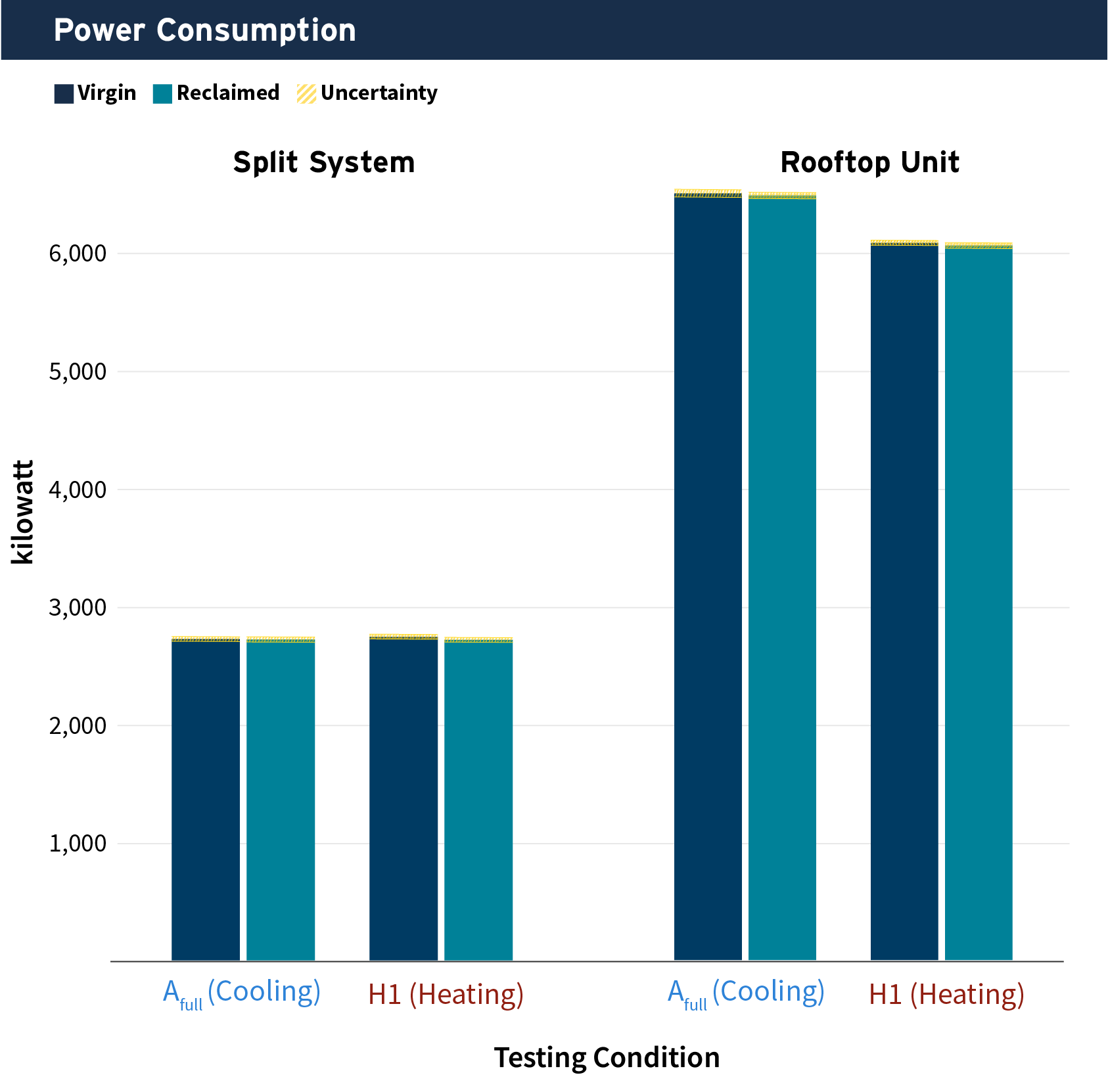
Note: This is a limited set of data. See full data across all test conditions and explanation of uncertainty in appendix of report.
The results were clear: In both systems, across all operating conditions, there were no statistically significant differences in performance between reclaimed and virgin refrigerants. Heating and cooling capacity, as well as energy efficiency, remained consistent and within expected uncertainty bounds. These findings demonstrate that reclaimed refrigerant meeting AHRI 700 standards is chemically equivalent to virgin refrigerant and delivers equivalent performance, reinforcing its viability as a reliable substitute for virgin supply.
As federally mandated HFC production and import caps tighten under the AIM Act, particularly by 2029 when the production cut reaches 70% from baseline levels, the gap between declining supply and ongoing servicing demand is expected to widen. Scaling reclamation can help meet this demand by unlocking supply from existing systems and supporting a more stable and cost-effective transition to low and ultra-low GWP cooling equipment in the long run. However, fully realizing this opportunity will require sustained coordination and alignment across contractors, distributors, refrigerant producers and reclaimers, equipment suppliers, and policymakers to make adoption of reclaimed refrigerant a standardized industry practice.
The Need for Responsible Management
For over a century, refrigerants have been central to the operation of air-conditioning and refrigeration systems that are integral to modern life. They enable cooling, heating, refrigeration, and climate control across sectors to safeguard comfort, public health, food safety, and the reliable operation of critical infrastructure. As air conditioning demand grows alongside a rise in electrification of heating through heat pumps, the total stock of equipment using refrigerants is expected to grow rapidly in both the United States and globally. This growth increases refrigerant demand for both new installations and for ongoing servicing of existing equipment.
A significant share of refrigerants in use today are hydrofluorocarbons (HFCs), a class of fluorinated gases (F-gases) with an exceptionally high global warming potential (GWP), meaning they trap far more heat per pound than carbon dioxide (CO₂) when released. Today, F-gases account for roughly 3% of total US greenhouse gas emissions (GHG) and more than 2% globally, exceeding the emissions of the entire aviation sector. Given their high heat-trapping intensity, unchecked refrigerant emissions could significantly worsen the impacts of climate change, making refrigerant management an important near-term mitigation opportunity.
To curb refrigerant emissions, the United States is advancing a transition under the American Innovation and Manufacturing (AIM) Act, which phases down HFC production and consumption across air conditioning and refrigeration applications in the residential, commercial, industrial, and transportation sectors. In parallel, the EPA’s Technology Transitions Program, is accelerating the shift to lower-GWP refrigerants by limiting the use of higher-GWP refrigerants in new equipment.
The phasedown schedule in the Exhibit 1 illustrates the declining allowable production levels over time:
While these transition policies reduce demand for high-GWP refrigerants in new equipment, existing systems will continue to require servicing throughout their remaining useful life. Heating and cooling systems, for example, are long-lived assets, often having a lifespan of 15 years or more. As a result, systems already in operation will continue to require these refrigerants over their remaining useful lives, and servicing demand will persist as equipment ages, leaks, and undergoes maintenance.
This presents a challenge: as the production of high-GWP refrigerants phases down under the transition, supply may decline more rapidly than what is needed to meet the servicing demand of the existing installed base, increasing the risk of a supply–demand gap. This report focuses on R-410A, where this supply-demand risk is expected to be particularly pertinent (Exhibit 2). R-410A is a high-GWP refrigerant with a 100-year GWP 2,0882 times that of CO₂, which in the year 2022 served approximately 85% of residential and 92% of light commercial cooling systems in the United States. Given the scale of R-410A in the installed equipment stock, the success of the HFC phase-down will depend not only on reducing new production, but also on how effectively existing refrigerant stocks are managed.
Exhibit 2
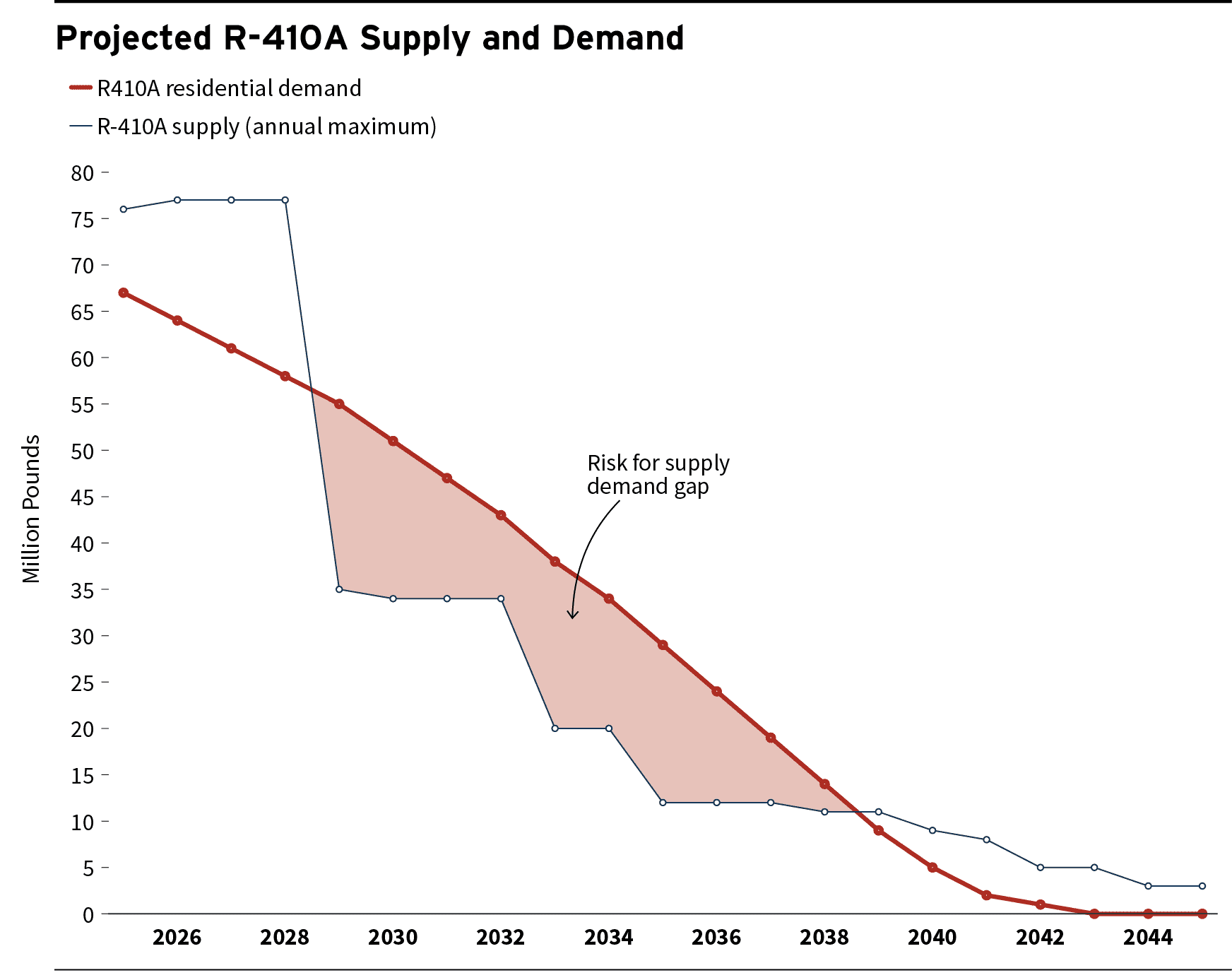
By 2029, demand for R-410A could outpace supply as production declines under phasedown policies.
Note: R-410A maximum annual supply estimate does not account for existing stockpiles. See source report for full methodology
Source: RMI analysis
While R-410A is highlighted throughout this report, the transition challenge and need for refrigerant management is applicable across sectors. Refrigerant emissions from leakage and venting result in both emissions and ongoing servicing demand for operating equipment, which will need to be addressed cost-effectively as supply tightens.
Existing equipment represents not only an ongoing source of demand, but also a largely untapped source of supply as equipment containing refrigerants reaches end of life. Improving the recovery and circulation of these materials will be critical to meeting servicing needs while reducing reliance on new production of high-GWP refrigerants during the transition.
Leveraging Untapped Supply
As the transition towards lower GWP refrigerant-based systems accelerates, meeting the servicing demand of installed equipment still reliant on high-GWP refrigerants will require looking beyond the shrinking supply of virgin refrigerant — refrigerant produced from raw materials such as hydrogen fluoride and other petrochemical compounds in the case of R-410A — and beyond existing stockpiles (i.e., refrigerant that has been produced or recovered and is not made available in open market or held in storage for future use).
A substantial source of potential refrigerant supply already exists within the installed base of equipment. The US EPA estimates that R-410A comprised approximately 39% of total installed HFC stock in 2022 (with over 80% residential and small commercial air conditioning equipment using R-410A), totaling over 431,000 pounds and demonstrating the magnitude of refrigerant contained within systems. While some of this refrigerant is inevitably lost during operational leakage and servicing, much of this refrigerant supply is recoverable. According to findings from a national contractor survey, more than half of retiring residential air conditioning and heat pump systems contain at least 75% of their total refrigerant charge at the end of life. This suggests that a large volume of refrigerant remains in equipment at the point of retirement and represents a recoverable source of supply.
Accessing this embedded supply depends on effective refrigerant recovery practices. Refrigerant recovery, defined as the process of removing refrigerant in any condition from equipment without necessarily testing or processing it, is a critical first step that determines whether refrigerant embedded in a system is captured or lost. In the absence of refrigerant recovery at end of an equipment’s life or during major servicing events where refrigerant is removed from equipment, the remaining refrigerant may be leaked or vented, eliminating its potential for reuse and reducing the volume of supply available to meet servicing demand.
Once a refrigerant is recovered, it can follow several pathways, depending on how it is processed and managed. These include recycling, reclamation, or destruction — the final path once a refrigerant is no longer used in equipment.
Refrigerant types
Virgin refrigerant: Refrigerant produced from raw material. For example, R-410A is synthesized from hydrogen fluoride and other petrochemical compounds.
Recovered refrigerant: Refrigerant that has been removed from equipment without necessarily testing or processing it. This is sometimes also referred to as reused refrigerant when it is reused in equipment.
Reclaimed refrigerant: Recovered refrigerant that has been reprocessed to the specifications outlined in the AHRI 700 standard, (i.e., the same purity standard of virgin refrigerant).
Recycled refrigerant is a refrigerant that has been removed from equipment and cleaned for basic impurities like oil and moisture (but not to the standard of reclamation). While recycling can reduce refrigerant waste and support localized reuse, a recycled refrigerant is only allowed to be reused in equipment of the same owner.
Another pathway is reclaiming the refrigerant. Reclaimed refrigerant is refrigerant that has been reprocessed at an EPA-certified facility to meet verified Air-Conditioning, Heating, and Refrigeration Institute (AHRI) 700 purity standards, identical to those required of virgin refrigerant. When recovered and reclaimed to meet AHRI 700 purity standards, this installed refrigerant bank can be returned to the market as a virgin-equivalent product, effectively converting it into a managed secondary supply stream.
Scaling up reclaimed refrigerant offers a promising path forward. As virgin refrigerant production declines under phasedown schedules, recovery and reclamation provide an opportunity to convert existing refrigerant into a usable source of supply while also reducing potential emissions from venting. In practical terms, capturing refrigerant from existing systems and reclaiming it to meet virgin-equivalent purity standards can reduce the risk of sudden shortages and extreme price spikes that delay repairs, strain contractor cash flow, and increase costs for building owners and households alike.
Scaling Reclaimed Refrigerant
Reclaimed refrigerant offers a scalable pathway to transform recovered refrigerant into a high-quality, market-ready supply stream to meet ongoing serving demand, yet it has not scaled sufficiently despite supportive policy signals under the AIM Act and a clear need for additional supply.
As of 2022, only between 3% and 10% of total annual HFC consumption in the United States is reported to the EPA as “reclaimed,” meaning the vast majority of refrigerant from retired equipment is either not being recovered, or is recovered but not ultimately sent for processing and reintroduced into the market as a reclaimed product. This limited scale, despite reclaimed refrigerant meeting equivalent purity standards to virgin refrigerant, reflects a combination of structural market frictions, inadequate incentives across the supply chain, and limited buyer confidence in reclaimed refrigerants.
As virgin refrigerant production declines under phasedown schedules, maintaining adequate supply will be critical to avoiding shortages, price volatility, and service disruptions for contractors and building owners alike. The European market provides a useful illustration of how reclamation can shape market outcomes under phasedown conditions.
For example, in the early years of implementation, supply constraints in Europe for certain refrigerants contributed to rapid price escalation — reaching 2.9 to 11 times higher than 2014 prices (pre-phasedown) — before easing as secondary markets and reclamation infrastructure scaled to meet demand. This experience highlights the importance of aligning recovery and reclamation capacity with phasedown and technology transition milestones to help avoid a similar scenario in the United States.
Today in the United States, a foundational regulatory framework exists to support the development of a reclaimed refrigerant market under the AIM Act phasedown, but it has yet to scale to meet its full potential. First, refrigerant venting is prohibited under Section 608 of the Clean Air Act, meaning refrigerant needs to be recovered, which precedes reclamation. Also under Section 608 of the Clean Air Act, all reclaimers must be EPA-certified and meet safe handling and management regulatory requirements. Lastly, for a refrigerant to be “reclaimed” it must meet AHRI 700 standards, which establishes chemical purity specifications that apply equally to virgin and reclaimed refrigerant, confirming defined chemical composition thresholds (as summarized for R-410A in Exhibit 3 below).
While AHRI 700 verifies chemical purity of refrigerant for both virgin and reclaimed, rigorous study of system performance parity between reclaimed and virgin refrigerants is limited in the public domain.
While technically either of these refrigerants can be expected to deliver equivalent performance, equipment owners, distributors, or contractors may be less familiar with the standards and perceive 'reclaimed refrigerant' as a risk to the equipment performance or customer experience. Independently published public data on reclaimed refrigerant's performance builds evidence to support market confidence in the use of reclaimed refrigerant across contractors, equipment owners, and policymakers.
Evidence of Performance Parity
To demonstrate system-level performance equivalence between virgin refrigerant and reclaimed refrigerant, RMI partnered with OTS R&D Inc., an engineering research and consulting firm founded by researchers from the University of Maryland specializing in heat transfer and thermal systems.
The central question guiding this work was whether the use of reclaimed refrigerant results in a measurable difference in system performance compared to using virgin refrigerant. More specifically, the testing evaluated heating and cooling capacity and energy efficiency in heat pump systems operating with reclaimed and virgin R-410A.
Although R-410A is being phased out of new equipment in the United States, it remains widely used in existing residential and light commercial systems — particularly in central ducted air conditioners and heat pumps, and packaged rooftop units — that will remain in operation and require servicing for years to come. Its substantial installed base makes it a leading candidate for demonstrating and scaling improved refrigerant management practices.
Given that reclaimed refrigerant must meet AHRI 700 purity standards — the same purity specifications required of virgin refrigerant — the ingoing hypothesis assumed no measurable difference in system performance between virgin and reclaimed sources. To disprove this hypothesis, any observed difference in heating or cooling capacity or energy efficiency would need to be larger than normal measurement uncertainty and consistent enough that it could not be explained by random variation.
Testing methodology
Two R-410A heat pump system types that dominate the residential and light-commercial market were selected for this performance testing to ensure the broad applicability of the results. The first was a three-ton split-system heat pump representative of typical US residential air conditioning and heat pump installations (Exhibit 4). The second was a five-ton packaged rooftop unit (RTU) heat pump, selected given the widespread deployment of this scale of RTUs across light commercial building types (Exhibit 5).
Exhibit 4
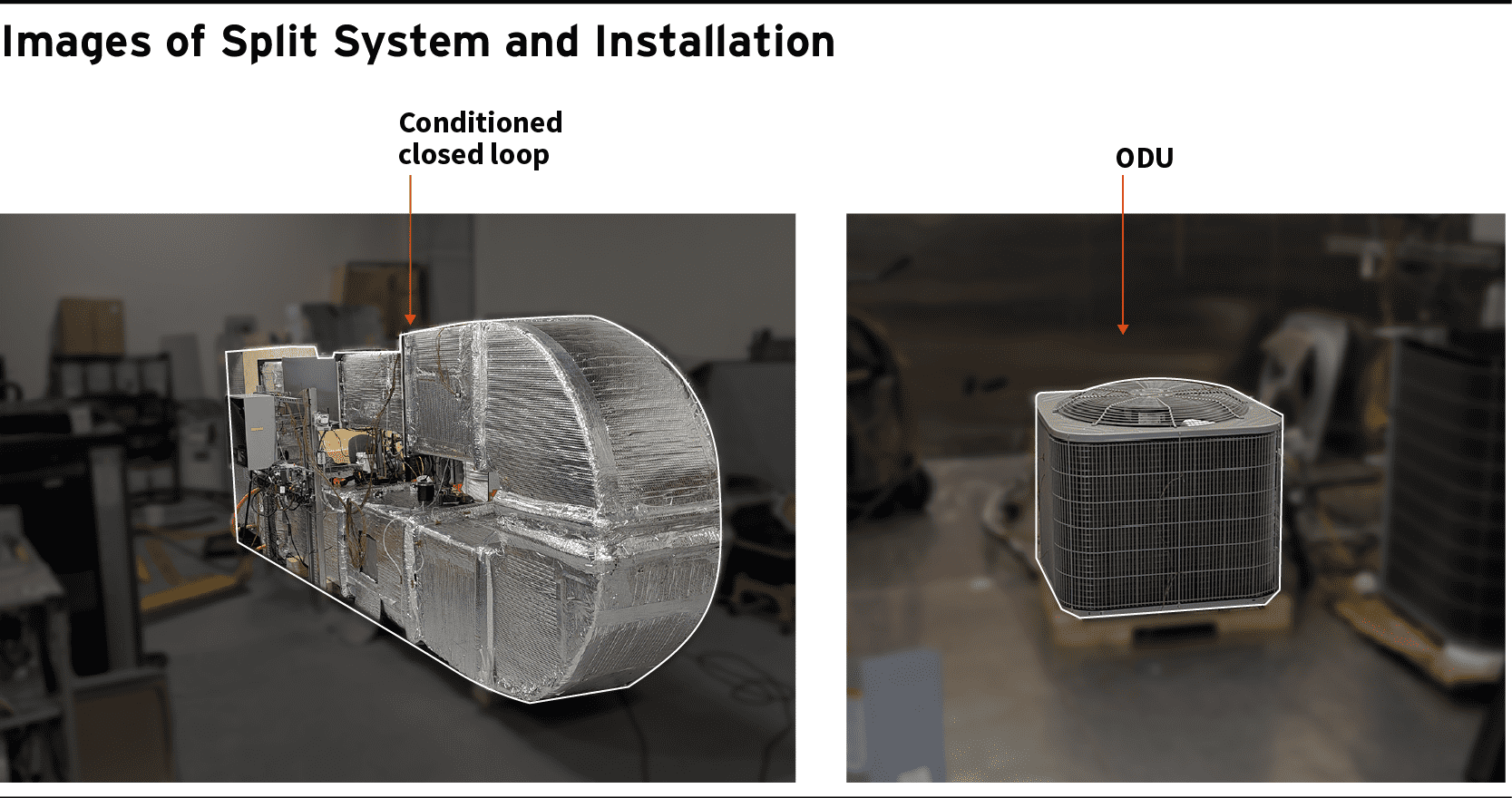
Credits: RMI Graphic. Image Source: OTS R&D
Exhibit 5
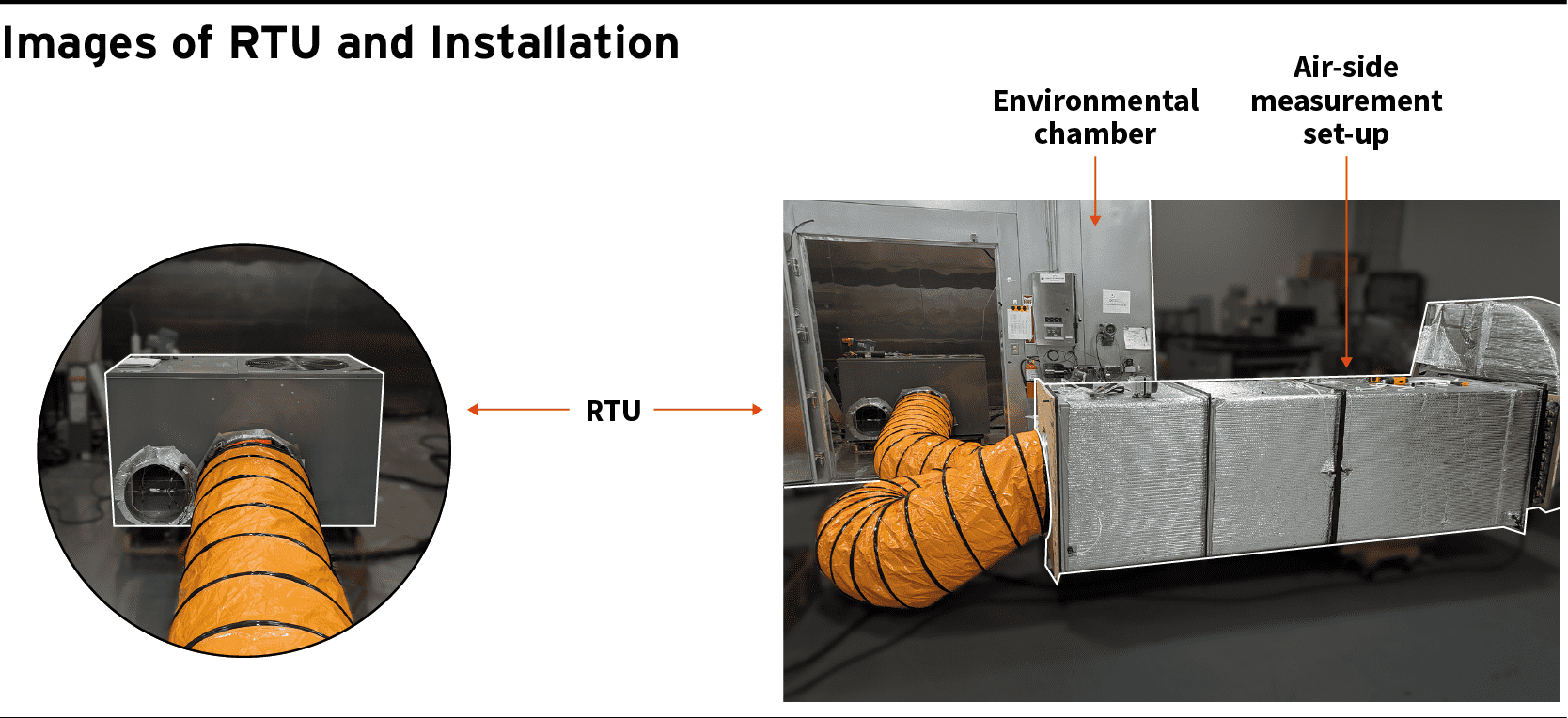
Credits: RMI Graphic. Image Source: OTS R&D
The performance of these two systems was evaluated in a laboratory using R-410A refrigerant sourced under two conditions:
-
Virgin refrigerant purchased directly from a supplier
-
Reclaimed refrigerant, purchased directly from an EPA and AHRI-certified reclaimer.
To assess potential performance deviation under conservative conditions, the purchased reclaimed refrigerant sample was tailored to reflect the maximum compositional variation permitted by the AHRI 700 standard, rather than “best-case” composition. In other words, this sample reflected the worse possible scenario in terms of quality of reclaimed refrigerant. Details can be found in the Appendix.
System performance of both heat pump systems was evaluated in accordance with AHRI 210/240, the industry standard for evaluating the performance of unitary air-conditioning and air-source heat pump equipment, and test method outlined in ASHRAE 37. Two cooling conditions (Afull and Bfull) and two heating conditions (H1 and H2) were used to compare heating and cooling performance at different temperatures. Details of the test conditions are described in Exhibit 6 below:
Where applicable for each test, capacity, electrical power consumption, efficiency, subcooling, superheat, suction pressure, and discharge pressure were measured or derived. Additional information on the test setup, instrumentation, measurement uncertainty, and performance metrics is detailed in the Appendix of this report.
Test results
Across both heat pump systems and different operating conditions tested, no statistically significant difference in performance was observed between systems operating with reclaimed refrigerant and those operating with virgin refrigerant. Measured cooling and heating capacity and efficiency values (in terms of coefficient of performance or COP) for reclaimed refrigerant were consistently aligned with those measured using virgin refrigerant and fell within the reasonable uncertainty bounds of the measurement process.
Exhibits 7 and 8 below depict a side-by-side comparison of capacity and efficiency results for virgin and reclaimed refrigerant across heating and cooling test conditions, illustrating the performance parity between systems using the two refrigerants. Results are normalized to the performance of the system using virgin refrigerant.
Exhibit 7: Residential ducted split system normalized performance results

Graphic: RMI, Source: OTS R&D
Exhibit 8: Packaged rooftop unit (RTU) normalized performance results
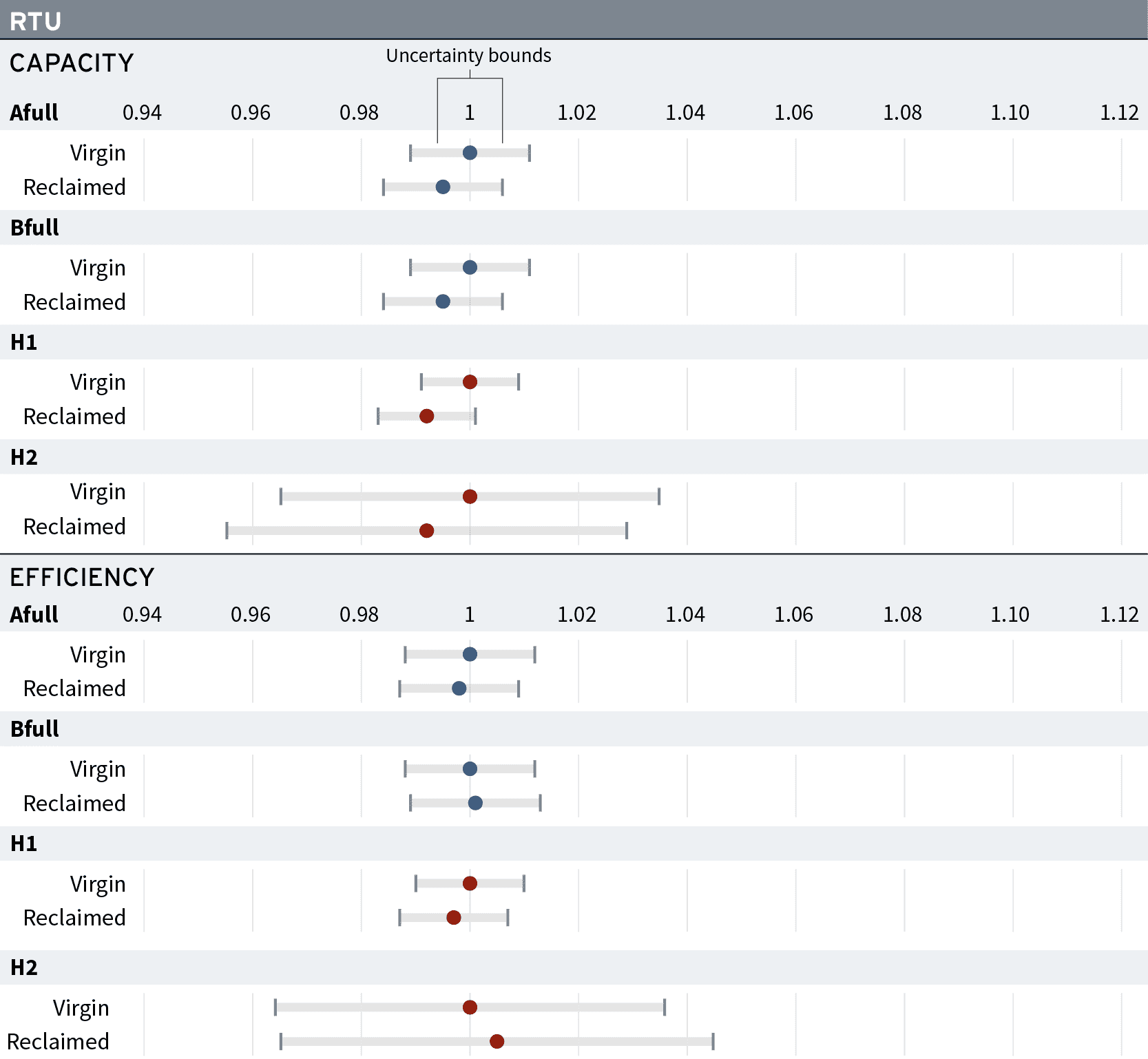
Graphic: RMI, Source: OTS R&D
Beyond the results presented above, three additional scenarios were tested to evaluate the effect of refrigerant conditions on system performance:
-
Charging from a nearly empty cylinder: As refrigerant cylinders are depleted in the real-world when contractors move from one site to another, there is an increased likelihood that non-condensable gases (NCGs)3 make their way into the refrigerant stream. A test was conducted on the RTU using reclaimed refrigerant charged from a nearly empty cylinder to simulate the “worst case” reclaimed condition where the most NCGs would enter the system. Under this scenario, measured system capacity and efficiency did not significantly vary from the virgin refrigerant test.
-
Direct reuse of recovered refrigerant: A recovered refrigerant sample was tested to represent a higher-impurity, field-recovered condition that had not undergone reclamation. This scenario showed the effect of a sample with elevated impurity levels on short-term system performance. It is important to note that recovered refrigerant quality is variable and is not certified to any standard, so the results observed here cannot be interpreted as universally applicable to recovered refrigerant samples more generally.
-
Refrigerant undercharge: The RTU was tested at lower charge quantities to understand the effect of leakage or undercharging on the RTU system performance. The system tested showed significant efficiency degradation when the charge was lower than 85% of it’s full charge, which is consistent with similar studies.
Details and testing data from these additional scenarios can be found in the Appendix.
These results validate that the thermodynamic performance of HVAC systems that use reclaimed refrigerants cannot be distinguished from those using new, virgin refrigerants. These findings can give system owners, operators, and technicians confidence that refrigerants that are reclaimed and certified to AHRI 700 specification should perform equivalently to new, virgin refrigerant, and that refrigerant circularity does not come at a performance trade-off.
The Path Forward to Scale
The refrigerant transition extends beyond just replacing high-GWP refrigerants; it requires redefining how existing refrigerant assets are valued and managed. The results of this work provide evidence regarding the performance of reclaimed refrigerant and can be used to inform technical and market considerations under phasedown conditions.
As HFC phasedown under the AIM Act progresses, constraints on virgin refrigerant supply are expected to intensify, particularly in 2029 when production limits tighten further. Maintaining stable access to refrigerants to service existing equipment will be essential to minimize cost impacts on end consumers and avoidable emissions. Therefore, treating refrigerant already in systems as a managed asset can strengthen market resilience while also advancing federal and global emission reduction goals. The testing framework applied here also provides a blueprint for managing refrigerant lifecycles beyond R-410A, supporting more resilient refrigerant transitions in the future.
Policy momentum supporting reclamation efforts is also accelerating. In late 2025, California launched the REFRESH pilot program — the state’s first initiative to directly incentivize reclaimed refrigerant. The program is expected to receive up to $5 million from the F-gas Reduction Incentive Program (FRIP) to fund refrigerant buyback and associated labor and administrative costs. New York and Washington have adopted complementary refrigerant management policies, banning bulk sales of some virgin refrigerants and strengthening data collection and refrigerant management enforcement efforts. While reclaimed refrigerant was historically not differentiated from virgin refrigerant, the EPA now requires explicit labeling of reclaimed refrigerant and will mandate its use for some sectors beginning in 2029.
Beyond policy momentum, market-based programs are also strengthening the case for reclamation. For example, Hudson Technologies and the DC Sustainable Energy Utility have partnered to launch the nation’s first utility-sponsored Refrigerant Recovery and Reclamation Pilot in Washington, D.C., which provides a financial incentive per pound of refrigerant recovered to participating contractors, alongside training and logistical support.
Reclamation, when supported by buyback programs, can convert recovered refrigerant into a monetizable asset, shifting refrigerant management from a compliance cost to a revenue-generating activity. Industry studies predict that under HFC phasedown, reclaimed HFCs in the United States will generate approximately $800 million in sales and support nearly 4,000 jobs. Strengthening accountability and incentives can further position reclaimed refrigerant as both a market resource and emissions-reduction strategy.
Fully realizing this opportunity will require sustained coordination across contractors, distributors, refrigerant producers and distributors, equipment manufacturers and suppliers, and policymakers to expand participation and make adoption of reclaimed refrigerant a standardized industry practice. For example:
-
Refrigerant reclaimers and distributors can institutionalize refrigerant reclamation through buyback programs, financial incentives, and clearer quality assurance frameworks to expand contractor participation and market confidence.
-
Contractors can normalize the use of reclaimed refrigerant in servicing and appropriate new installations, supported by continued technical education and standardized handling practices.
-
End users can reinforce market signals by incorporating reclaimed refrigerant into procurement discussions and service specifications.
-
Equipment and component manufacturers can leverage reclaimed refrigerant in servicing contracts with end users and in new equipment where applicable.
-
Policymakers can align incentives and reporting frameworks to recognize reclamation as a core supply-side strategy for maintaining legacy HFC systems during phasedown.
This study demonstrates performance parity for HVAC systems using virgin and reclaimed refrigerant, strengthening the foundation for its broader adoption in the marketplace. As the refrigerant transition progresses under the AIM Act, reclaimed refrigerant offers a practical way to help meet servicing demand while reducing emissions and can play a meaningful role in supporting a smoother transition to lower-GWP alternatives. The opportunity now is for the industry to build momentum around improved refrigerant management.
RMI is grateful to the Grantham Foundation for the Protection of the Environment for their generous support of this work.
Endnotes
Appendix
Download the Appendix here.