Aerial view of electrical substation near town on sunny day, Oregon, USA.

Solving the Gridlock: America’s Electric Supply Chain Opportunity
As surging demand strains an aging power system, grid hardware is in short supply. Here's how policymakers can help.
Demand for key grid hardware has soared since 2019, due to large load growth, integration of new energy generation resources, and investment to modernize the aging grid. This demand is driving up equipment lead times and prices. In fact, if you need a large power transformer, you may have to wait up to four years. The stakes are high for American businesses and consumers: the grid supply chain crunch is already impacting utility bills, threatening reliability, and stalling critical projects, from power plants and data centers to new housing construction.
While recent investment announcements in domestic grid component manufacturing will help ease shortages in the coming years, these developments on their own are not enough to secure America’s grid supply chain. Policymakers can leverage a range of proven industrial policy tools to boost the capacity, coordination, and competitiveness of US grid component manufacturing. Addressing the gridlock is an opportunity to reinvigorate domestic manufacturing, strengthen US energy security, improve energy affordability, and propel economic growth.
What is the grid supply chain?
The electric grid is a complex network that connects energy generators to customers. High-voltage transmission lines carry electricity over long distances from power plants to substations, while low-voltage distribution lines deliver power from substations to homes and businesses. Substations serve as critical nodes connecting the generation, transmission, and distribution networks, leveraging transformers, switchgear, circuit breakers, and other equipment to adjust voltage, convert current, and protect electricity infrastructure.
Exhibit 1
Grid Supply Chain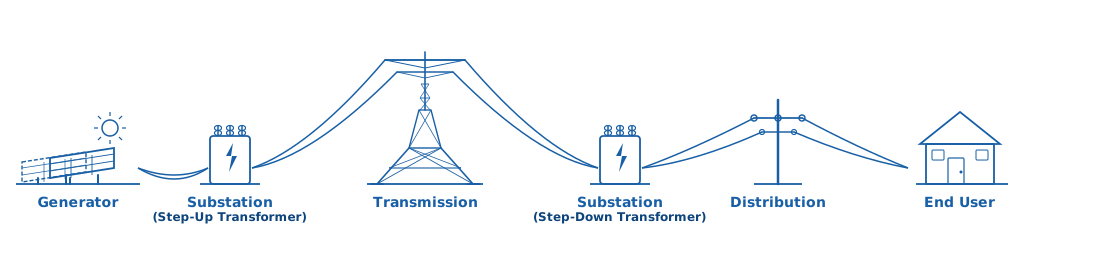
Grid components rely on material inputs like aluminum, copper, and specialized steel. Recent innovations in grid hardware — such as high-performance conductors, high-voltage direct current (HVDC) transmission, solid-state transformers, and other grid-enhancing technologies — aim to expand existing grid capacity, improve manufacturability, and ease integration of distributed and remote energy resources (see the Appendix for an overview of the essential grid building blocks, their material inputs, and innovation opportunities).
Supply chain constraints
Today, the grid faces serious supply chain constraints, and US production capacity remains limited.
Demand for grid equipment has surged in recent years (Exhibit 2), resulting in long lead times (Exhibit 3) and elevated prices (Exhibit 4). The cost of cables for power lines, for example, has doubled since 2019, and power transformer prices have increased by around 75%. Rising grid equipment prices can have a ripple effect on the costs of electricity for business and residential consumers. According to analysis from the Lawrence Berkeley National Laboratory, distribution and transmission expenditures, impacted by supply chain constraints, have contributed to recent increases in consumers’ electricity bills.
Exhibit 2
Exhibit 3
Exhibit 4
High demand for grid equipment is due to several factors. For one, electricity demand is growing rapidly, driven by data centers and manufacturing investment as well as increasing use of electricity for transportation, household appliances, and heating. Integrating new large loads and generation resources requires a steady supply of new transformers, switchgear, wires, and cables. In addition, with existing grid infrastructure approaching the end of its useful life or subject to extreme weather events, replacing aging or damaged stock is driving demand for grid hardware. Due to these structural factors, grid equipment market deficits are expected to persist through at least 2030 (Exhibit 5).
Exhibit 5
The United States relies on imports to meet a large portion of grid equipment demand. Some critical components have limited to no domestic manufacturing capacity. In 2025, domestic production met only 20% of US large power transformer (LPTs) demand (Exhibit 6) and about 50% of US distribution transformer demand. The United States is also a net importer of switchgear. Across the grid supply chain, America imports primarily from Mexico, Southeast Asia, and Europe (Exhibit 7). However, the United States has some direct and indirect exposure to China.
Exhibit 6
Exhibit 7
A diversified global market is a strength, and the United States will need to continue to partner with allies to secure supply. However, high import reliance and exposure to foreign entities of concern also leaves the country vulnerable to potential supply chain disruption, with limited power to address elevated lead times and prices. With a demand-supply gap projected to persist, boosting domestic production of grid components and materials is one key strategy to mitigate supply chain risk. Domestic production also creates manufacturing jobs and propels economic growth.
Boosting capacity, coordination, and competitiveness
Despite some reshoring progress, further action is needed to secure America’s grid supply chain.
Manufacturers are starting to respond to grid supply chain shortages with several recent announcements for new or expanded production capacity in the United States. For example, Hitachi Energy announced a $1 billion investment in transformer and grid equipment manufacturing with a new factory in Virginia, and Siemens Energy targets new US transformer capacity by 2027. The US-Japan Framework Agreement negotiated in 2025 also features grid equipment investment commitments.
These developments, while encouraging, are insufficient to close the 2030 supply chain gaps. Manufacturers have taken a relatively cautious approach to new investment so far, with historical boom and bust cycles leading executives to question whether demand will persist. In addition, the United States must overcome supply chain challenges related to material inputs, workforce capacity, and utility procurement:
- Material inputs: Recent investments focus on grid equipment final assembly but do little to address capacity or dependencies in specialized steel, copper, and aluminum. The United States has limited domestic copper refining capacity and only two commercial suppliers of grain and non-grain oriented electrical steel (GOES and NOES), as well as only one domestic supplier of amorphous metal, an electrical steel alternative with improved material properties.
- Workforce: Grid equipment manufacturers report challenges recruiting and maintaining skilled workers, citing technical labor shortages as one of the largest impediments to expanding capacity.
- Utility procurement: Utilities have bespoke transformer designs with different size and voltage requirements to serve customer load. The high degree of design customization (e.g., over 80,000 types of transformers) constrains the industry’s ability to scale production and build supply chain resilience across project portfolios. Utility procurement practices around preferred suppliers can also make it difficult for new manufacturers to get certified.
Consequently, the United States remains undersupplied. The production that does exist is not cost-competitive with imports due to higher costs of materials and labor, as well as specialization that limits economies of scale. Domestically produced transformers, for example, are estimated to be 10%–25% more expensive than imported transformers. Targeted policy interventions, discussed in the next section, can help build capacity, improve coordination, and cut costs.
What federal policymakers can do to address the gridlock
Without policy interventions, the United States will struggle to meet grid equipment demand, posing serious threats to the electricity system and economy. Thankfully, there are a range of potential solutions to strengthen America’s grid supply chains, and federal policymakers are starting to respond.
In January 2026, the Department of Energy’s (DOE’s) Office of Electricity was provided $375 million to enhance the domestic supply chain for transformers and other electric grid components and materials. In an April 2026 memorandum to DOE, the Trump Administration made a determination under the Defense Production Act (DPA) to expand domestic grid supply chain capacity, described as “dangerously limited.” DPA authorizes a wide range of tools including purchases, purchase commitments, and financial support for production, though funding to execute will depend in part on future Congressional action.
Below are policy solutions that DOE could consider as the agency puts the new grid supply chain funding to use and implements the DPA, as well as further steps Congress could take to address this challenge. Policy interventions are organized into three sections: (1) easing near-term bottlenecks, (2) expanding domestic capacity, and (3) promoting innovation. While the benefits of these interventions will materialize over different timeframes, policymakers should consider strategies in all three sections.
Strategies to ease near-term grid supply chain bottlenecks
Over the near term, policymakers should focus on optimizing existing grid capacity, partnering with allied countries, ramping up production at existing facilities, and enhancing industry collaboration. Aided by recent appropriations, DOE can implement several of the recommendations below. The FY27 appropriations cycle could provide more funding to ease near-term bottlenecks, while reauthorization of the Energy Act of 2020 presents an opportunity to codify a DOE grid supply chain program.
- Promote alternate grid solutions. There are several near-term solutions that can help utilities more efficiently use existing infrastructure to delay purchases of new transmission and distribution equipment. These include virtual power plants, advanced transmission technologies, demand flexibility, and clean repowering. Federal policymakers should focus on solutions to reduce barriers to deployment and consider parallel efforts to improve electricity affordability.
- Pursue partnerships with allied countries. Building from the US-Japan framework, policymakers could integrate grid equipment into trade deals to help secure near-term supply. Despite global shortages, some individual countries have spare production capacity, and DOE could play a role facilitating new supplier relationships to help build trust between utilities and global manufacturers outside their current list of preferred suppliers.
- Boost existing production. Ramping up production at existing grid equipment factories can ease shortages more quickly than greenfield investments. Manufacturers could increase shifts, invest in productivity initiatives, and expand production lines. If up-front capital, labor, or demand uncertainty remains a barrier to expansion, DOE could provide support through credit enhancements, workforce development initiatives, or by coordinating offtake.
- Enhance industry collaboration. DOE could leverage its convening powers to bring grid component manufacturers, utilities, and other industrial customers together to improve understanding of supply chain risks and enable collaborative problem solving. DOE convenings, or a revived supply chain tiger team, could facilitate mutual sharing agreements between utilities with backup inventories to overcome near-term bottlenecks. Convenings could also help the industry align on longer-term volumes, standardize designs, and collaborate on workforce development to give manufacturers the certainty they need to invest in new capacity.
- Secure critical material inputs. The Administration could leverage the newly created Project Vault, an EXIM-backed stockpile, to ease materials availability challenges and volatile commodity markets for specialized steel and other critical materials.
Strategies to expand domestic production of critical grid components
Greenfield facilities can take multiple years to reach full production, but making these investments today is vital to maintain the stability and growth of the US electric grid, mitigate exposure to future supply chain disruptions, and capitalize on the economic opportunity of domestic manufacturing. Policymakers should consider the following strategies to incentivize new manufacturing capacity investment, prioritizing grid components and materials at the highest risk.
- Expand manufacturing tax incentives. Congress could expand the existing advanced manufacturing production and investment tax credits to the grid supply chain. Tax incentives would help close the cost of production gap with imports and spur investment in new manufacturing capacity by boosting project returns. Tax credits for the grid supply chain should be designed to support engineered materials and finished goods, including next-generation components. One approach would be to create an investment tax credit for new manufacturing facilities (e.g., appropriating funds to the 48C program for which grid equipment is already eligible), while providing a production tax credit for the material inputs and components (e.g., adding the grid supply chain to 45X). This structure would drive investment in new manufacturing capacity while addressing raw material constraints upstream.
- Ensure access to low-cost scaling capital. Federal loan programs can provide cheap capital to scale production and improve competitiveness. For example, DOE’s Energy Dominance Financing Program could provide low-cost loans and loan guarantees for grid equipment and materials production. In addition, DPA Title III can be used to fund the construction or expansion of plants through grants, loans, and loan guarantees to make products in short supply that are critical to national defense and energy security. Congress could support grid manufacturing by reauthorizing DPA and making appropriations to the DPA Fund.
- Address non-cost barriers to production. Beyond tax credits and loans, policymakers should address other barriers to production, such as labor availability, high degrees of customization, and demand uncertainty. DOE could partner with the private sector on workforce development and equipment standardization and consider facilitating commitments to binding volumes between utilities and manufacturers. To the extent demand uncertainty hinders new manufacturing investment, the federal government could step in as an anchor buyer or purchaser of last resort, using DPA authorities or DOE’s other transaction authorities to create a virtual strategic transformer reserve, helping to smooth boom and bust cycles and promote equipment standardization. To improve manufacturing competitiveness, the federal government could also consider programs to incentivize advanced manufacturing techniques and promote industrial clustering that prioritize regions’ existing economic capabilities and industrial strengths.
Strategies to promote grid technology innovation
Grid hardware is evolving quickly, with next-generation technologies emerging from innovative LPTs and solid-state substations to HVDC transmission and high-performance conductors. Several US-based start-ups are building grid hardware that improve performance, circumvent raw material constraints, and have flexible, interoperable designs. Policymakers can help foster and commercialize these innovations in the United States.
- Invest in research, development, and demonstration (RD&D) for grid supply chains. DOE, in partnership with the National Laboratory system, could support the private sector in developing and testing next-generation grid components through programs like Transformer Resilience and Advanced Components, Small Business Innovation Research, Small Business Technology Transfer, and other prizes and competitions. Congress could also consider appropriating additional funds for grid hardware R&D.
- Facilitate pilots with utilities. DOE could accelerate adoption of advanced grid components by funding pilot and demonstration programs with utilities to de-risk first-of-a-kind deployment of advanced technologies, building from recent Grid Innovation Programs.
- Support early commercialization. To support early-stage grid component manufacturing, DOE could expand access to pilot production lines and demonstration-scale manufacturing through programs like ARPA-E SCALEUP or the Technology Commercialization Fund.
Seizing the subnational economic development opportunity
Strengthening the grid supply chain would create opportunity for economic growth in states and regions across the country. For example, recent analysis in California found that if in-state production met 30% of grid equipment demand, it would create up to 12,000 sustained, full-time jobs. To position their regions to attract manufacturing investment, state and regional policymakers and economic development leaders can do the following:
- Map the overlaps between their region’s industrial base and the production processes for different types of grid equipment. This exercise builds a high-level frame of reference on the types of grid equipment manufacturing, in both technology and supply-chain stage, that most closely align with accumulated regional workforce strengths. For example, transformer manufacturing clusters often co-locate with lubricating oil manufacturing. This likely reflects the use of insulating materials in the supply chain for conventional large power transformers.
- Facilitate the development of tailored workforce training programs. Like many fast-growing electro-industrial sectors, grid equipment manufacturers cite persistent challenges in finding skilled technical workers. Consequently, manufacturers have cited flexible workforce programs as a key factor in deciding where in the country to locate new projects. Nation-leading workforce development programs across the Southeast are part of why states like North Carolina, South Carolina, Tennessee, and Virginia have led the way in attracting grid manufacturing investment over the past decade. Tailored and flexible workforce development programs allow states to compete for the types of anchor projects that can catalyze new manufacturing clusters.
Exhibit 8
- Encourage coordination that accelerates equipment standardization and strengthens demand signals. Federal policymakers are not the only leaders who can facilitate equipment standardization. Economic developers can play a key role as well. It is their job to engage with utilities, anchor institutions, manufacturers, university leaders, and an array of other regional stakeholders daily. They can facilitate the development of institutions that coordinate equipment procurement that in turn strengthens market signals that justify new manufacturing investment. The proposed California Grid Manufacturing Initiative would, if enacted, embody this approach.
For more information on regional investment attraction, see RMI’s GREASE Lightning: A playbook for investment-led, state-driven electro-industrial economies.
Now is the time to strengthen America’s energy supply chains
By implementing strategies to ease near-term bottlenecks, boost domestic production, and accelerate innovation, policymakers can help ensure the United States has access to the critical components and materials it needs to bring new projects online while keeping energy inflation in check. Making more grid equipment in America will also bolster national security, support thousands of manufacturing jobs, and unlock potential export opportunities in a sector ripe for innovation.
The New Energy Industrial Strategy Center
The NEIS Center is a thought partner, funder, and community builder that helps create advanced energy systems that support competitive economies and power the industries of the future.