
Five Takeaways from the First Large-Scale Pilot of the RESNET/ICC 1550 Embodied Carbon Standard
100 Massachusetts homes reveal how embodied carbon assessments can scale in the homebuilding sector.
RMI’s HomebuildersCAN program is leading the development of the first embodied carbon standard — RESNET/ICC 1550 — for the home building sector in the United States. Thanks to the efforts of a remarkable team[1] in Massachusetts, the draft version of this standard was given a unique test-drive via the Massachusetts 100-Home Embodied Carbon Study, released in December 2025. This ground-breaking report is the first major study of new home construction in the United States with a common embodied carbon methodology and is full of great insights for home builders.
The RESNET/ICC 1550 Standard enables professional Home Energy Rating System (HERS®) Raters to measure and report embodied carbon. These raters analyze and score the energy efficiency of over 400,000 new homes every year using the same scoring and analysis models . Through the 100-Home Study, 13 HERS® Raters generated 100 home embodied carbon assessments using the industry standard Ekotrope software, supported by training and beta tools to connect their existing models with the BEAM tool for measuring and reporting embodied carbon.
The resulting report is rich with detail, with 113 pages of in-depth results and analysis.
Here are our top five takeaways from the report:
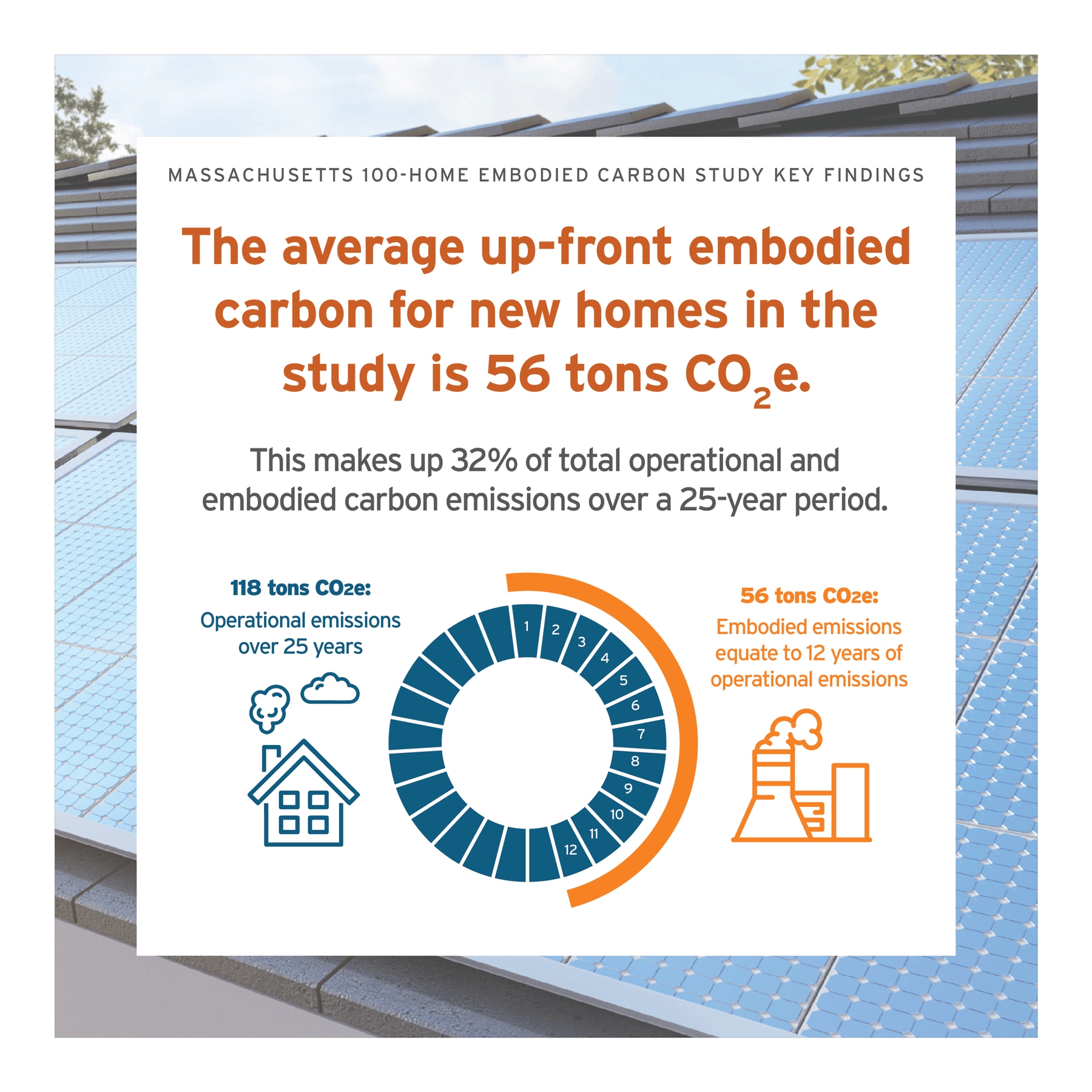
1. The average new home in Massachusetts is responsible for 56 tons of embodied carbon emissions (ECE), measured as carbon dioxide equivalent (CO2e).
Using results from the HERS® ratings, the average home in the study will be responsible for 118 tons of CO2e of operational carbon emissions (OCE) over its first 25 years of occupation. At that rate, it will take 12 years before a typical Massachusetts home’s operational emissions surpass its embodied emissions. In other words, embodied carbon will dominate the emissions profile of new homes for at least a decade.
The 100-Home study also provides detailed insights into how building typology, electrification, and materials can have significant impacts on ECE and OCE.
2. The level of energy efficiency of a new home is not a predictor of embodied carbon performance.
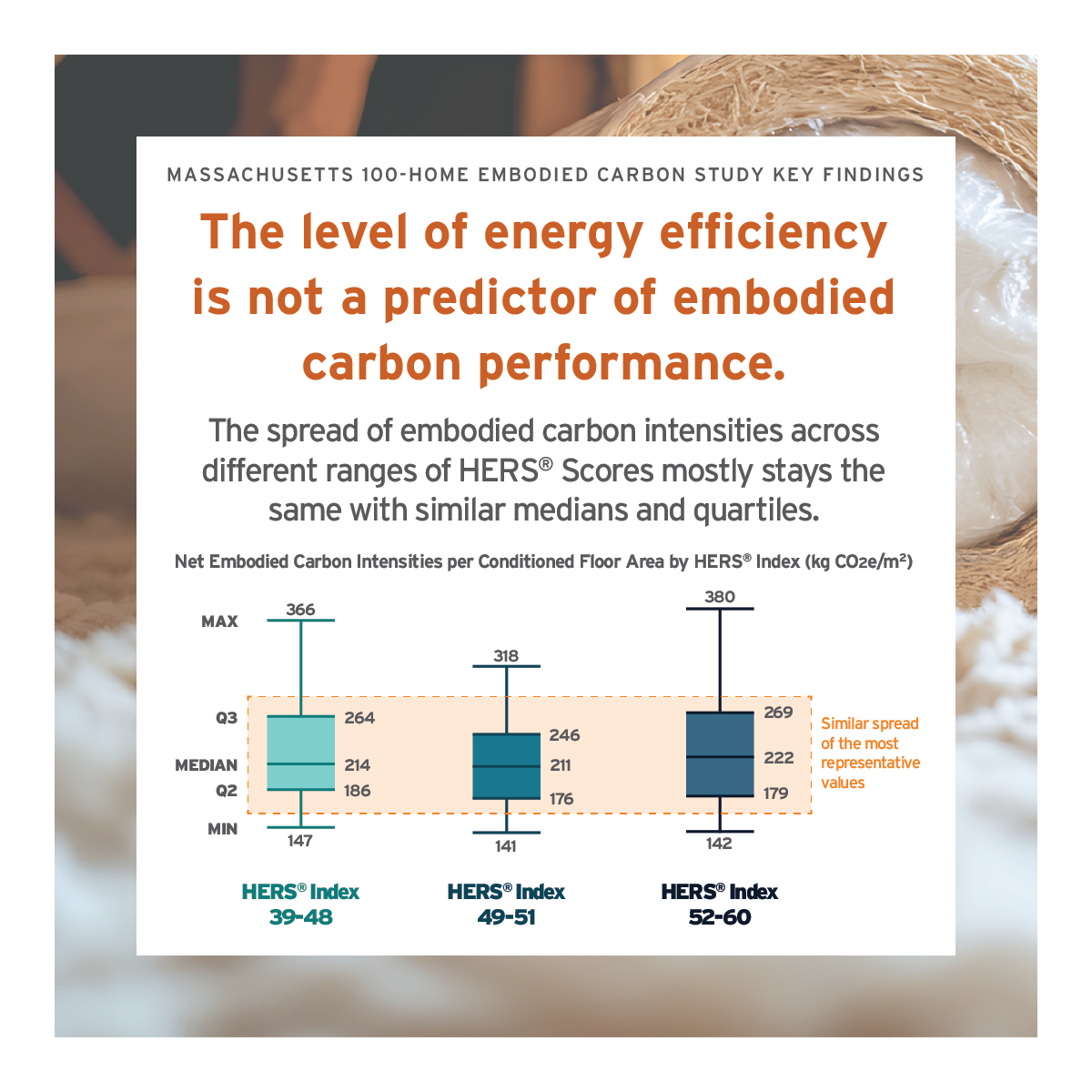
Despite industry concerns that improved energy efficiency might drive embodied emissions higher, or that reducing embodied emissions might result in worse operational efficiency, the level of energy efficiency of a new home is not a predictor of embodied carbon performance.
Instead, the study showed very little difference between the embodied carbon intensity of new homes, regardless of the HERS® rating. The median result of higher performing homes with a HERS® Index of 39–48 was nearly identical to the median results of homes with worse HERS® scores. In fact, the bulk of the embodied carbon results fell within very similar values, and even the embodied carbon outliers (those with particularly high or low embodied carbon intensities) were similar.
This should help reset assumptions that ECE and OCE emissions will negatively impact one another. Instead, these results indicate that it is entirely possible to achieve an outstanding HERS® score and industry-leading embodied carbon results.
3. Embodied carbon results in Massachusetts are very similar to those from other studies of new homes elsewhere.
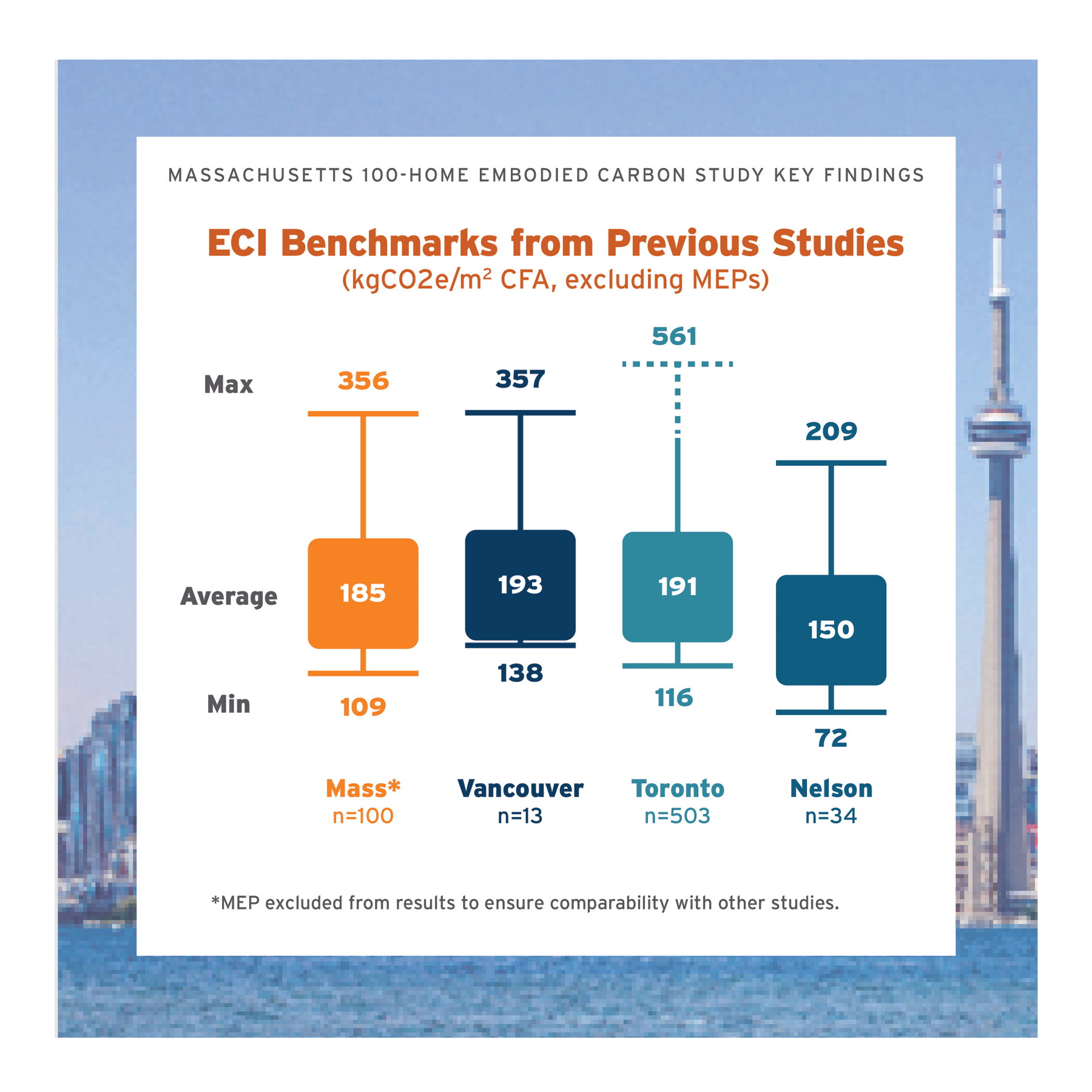
The outcomes of multi-home studies in Canada by Builders for Climate Action reveal average embodied carbon intensity (ECI) values comparable to those observed in Massachusetts. The results studies show similar outliers at both the high- and low- ends.
While more work is needed to fully understand regional variations in embodied carbon outcomes, results across climate zones 4–6 suggest that homes can achieve similar levels of embodied carbon performance regardless of geography. This consistency is not surprising, given that residential construction practices, material supply chains, and design approaches are largely similar across North America.
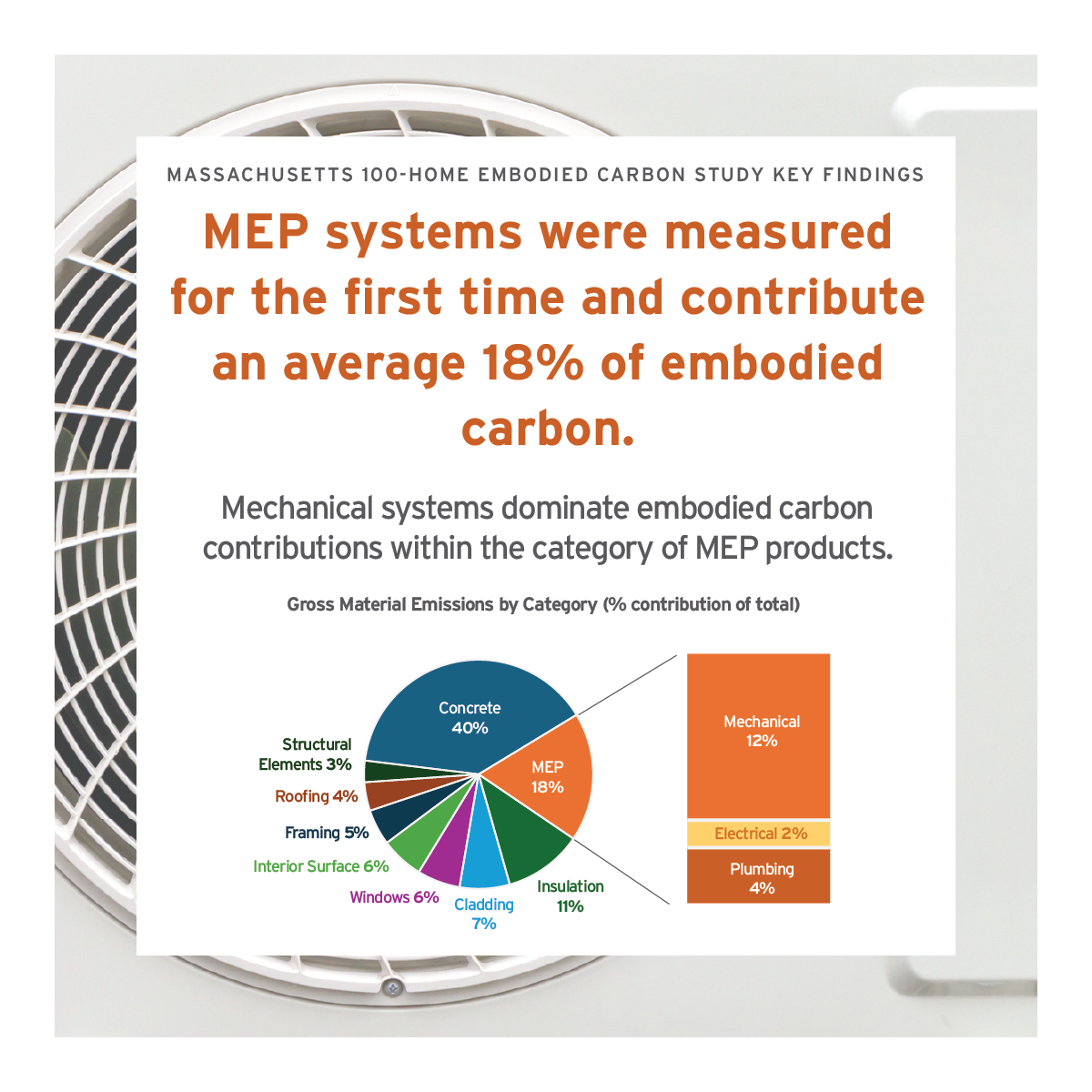
4. Roughly 18% of a new home’s embodied carbon comes from MEP (mechanical, electrical and plumbing). This is the first time the RESNET/ICC 1550 default table has been used to demonstrate this significant contributor.
Previous studies and tools for new homes have not included embodied carbon for mechanical, electrical, and plumbing (MEP) systems, leaving a meaningful portion of emissions unaccounted for. Using the draft tables in the 1550 standard, the study found that MEP systems contribute an average of 10 tons of CO2e per home, which is 18 percent of total embodied carbon.
By capturing these impacts, the 1550 standard closes a significant gap in carbon accounting and highlights an important opportunity for emissions reductions. The study also provides detail about the types of MEP equipment that can influence embodied carbon outcomes to help builders and policymakers target high-impact decisions.
5. Early results show embodied carbon assessments are practical and manageable.
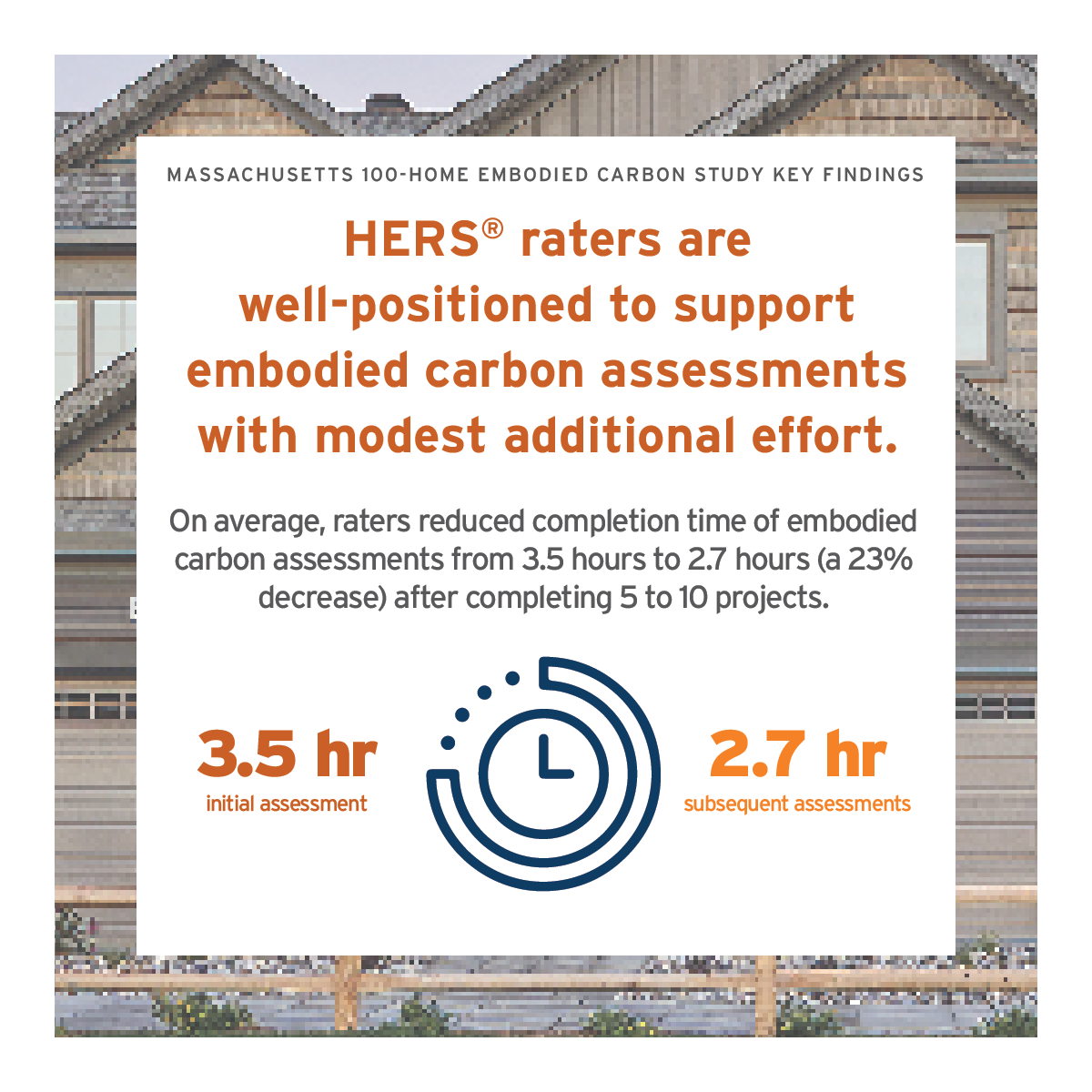
The HERS® Raters participating in this study were among the first in the industry to receive training to do embodied carbon assessments of new homes, and they did so using beta software integrations. Even at this early stage of training and software development, the time required to complete an embodied carbon assessment decreased by 23 percent to 2.7 hours per assessment. Some HERS® Raters were able to complete an embodied carbon assessment in 1–2 hours.
Despite this early-stage environment, the study found that HERS® Raters were uniquely well-positioned to provide embodied carbon assessments for clients by leveraging much of the modeling data already generated through the HERS® rating process.
The study also captures practical feedback from participating HERS® Raters on how embodied carbon assessments could be completed faster and with less friction.
The MA 100 Homes study is a timely preview of the practicality of undertaking embodied carbon assessments and the valuable insights this can provide into affordable, achievable decarbonization efforts for new homes. HomebuildersCAN is grateful for the work done by the HERS® Raters and the study team for creating a rich data set and so much valuable insight and analysis.
The RESNET/ICC 1550 Standard is moving toward publication in Q2 2026 and will make it possible for any trained home designer, builder or energy rater to perform an embodied carbon assessment. Follow HomebuildersCAN to get timely updates about the progress of 1550 and upcoming training opportunities.
Thank you to the authors and contributors of the Massachusetts 100-Home Embodied Carbon Study.
[1] Massachusetts Clean Energy Center, National Grid, Eversource, Northeast Home Energy Rating System Alliance, Stephens & Company, Inc., Home Energy Raters, Builders for Climate Action, NMR Group, Inc.